ROHINGYA SEA CROSSINGS: A LAND CRISIS DRIVING DANGEROUS MARITIME MOVEMENTS
Date issued: 18 September 2026
“Rohingya sea movements are no longer a seasonal issue at the margins of commercial shipping. Conflict in Myanmar, prolonged displacement in Bangladesh and adaptable smuggling networks are sustaining dangerous departures across the Bay of Bengal and Andaman Sea. Merchant vessels can become first responders without warning, and the burden often continues long after the rescue. Tighter enforcement may change routes and methods without reducing demand, so falling arrival figures should not be read as falling risk.”
EXECUTIVE SUMMARY
- Fighting in Rakhine State, on Myanmar’s western coast, escalated again from 3 September, with naval shelling of the Gwa and Thandwe coasts, airstrikes across three townships and a ground offensive towards Ponnagyun, held by the Arakan Army (AA), the ethnic armed group that took most of the state from the military. Thousands were reportedly displaced. These are the conditions that precede movement by sea.
- Malaysia plans to return 1,476 Myanmar nationals on 29 September. The United Nations High Commissioner for Refugees (UNHCR) said on 1 September that it has no role and that Myanmar is not safe for return.
- More than 500 people are feared dead or missing after two boat disasters in June and July, though figures remain unconfirmed. 2025 was the deadliest year recorded: more than 6,500 attempted crossings, nearly 900 dead or missing, and what UNHCR calls the highest mortality rate of any major refugee and migrant sea route worldwide.
- The problem begins on land, at both ends of the route. Territorial control in Rakhine has changed hands, but UN agencies and rights organisations assess that conditions for safe return have not followed, documenting serious abuses against Rohingya by both the Myanmar military and the AA.
- Disruption to scheduled shipping remains limited, but a single encounter can mean diversion, medical demands and prolonged uncertainty over disembarkation. Rescued groups may also be of mixed status.
EVENT
Rakhine State saw renewed fighting in the first week of September 2026. Myanmar navy vessels reportedly shelled coastal areas of Gwa and Thandwe on 3 September, and aircraft struck villages across Sittwe, the military-held state capital, and neighbouring Ponnagyun and Rathedaung. On 9 September, the United Nations said hostilities since 3 September had displaced more than 1,100 people across Gwa, Ponnagyun, Rathedaung and Thandwe. Local reporting indicated that fighting along the Sittwe–Ponnagyun front continued through at least 12 September. Detailed battlefield reporting remains difficult to verify independently and relies largely on Rakhine-based and exile media citing residents and military sources.
Conditions at the destination end are shifting in parallel. Malaysia’s Home Ministry announced on 27 August that the first phase of a voluntary repatriation programme will proceed on 29 September, involving 1,476 Myanmar nationals identified by Myanmar authorities. UNHCR said on 1 September that it had no role and that continuing conflict made safe, dignified return impossible. Malaysia maintains that participation is voluntary.
These follow the deadliest reported incidents of 2026. On 16 July, the International Organization for Migration (IOM) and UNHCR said they were investigating reports that two boats carrying more than 500 people had capsized off Myanmar after leaving Rakhine State in late June. Médecins Sans Frontières (MSF) separately reported a sinking on 29 June with no survivors. The accounts broadly correspond, but the link between them and the final toll remain unestablished. The figures tabulated below are reported rather than confirmed.
No comparable disaster has been reported since. That is not evidence of improvement; the pressures behind these movements are intact.
CONTEXT
Movements rose sharply as fighting in Myanmar intensified. More than 7,800 Rohingya attempted boat journeys in 2024, an 80% increase on 2023, with more than 650 dead or missing and children accounting for 44% of passengers. UNHCR also recorded departures shifting from mainly Bangladesh in 2023 to mainly Myanmar from 2024.
The pattern has carried into 2026. Save the Children’s analysis of UN data found 2,907 departures from Bangladesh and Myanmar in the first quarter, against 1,571 a year earlier, an increase of about 85%.
Figure 1. Principal reported incidents since May 2025
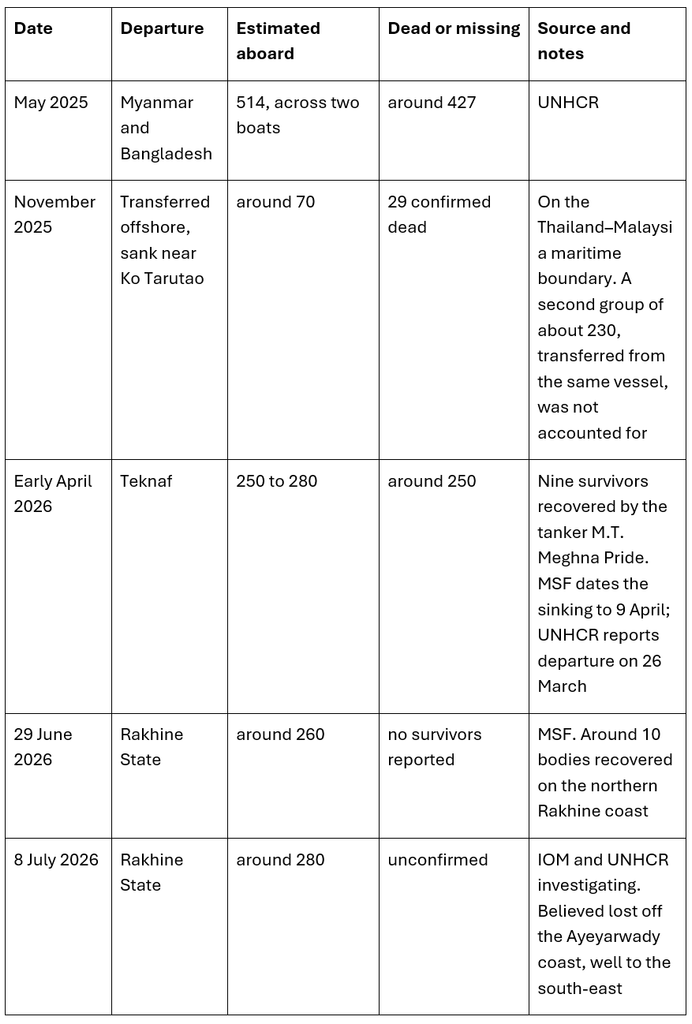
Note: Compiled by Ambrey from UNHCR, IOM, MSF and media reporting. Passenger and casualty figures are reported estimates rather than verified totals. Agency figures for the same incident frequently differ, and may be revised as further information emerges.
The April case is the one with direct commercial relevance. Teknaf, at the southern end of Bangladesh’s Cox’s Bazar district, is a major departure area for irregular sea journeys towards Malaysia. The Bangladesh-flagged M.T. Meghna Pride was sailing from Chattogram to Indonesia when it encountered nine people drifting near the Andaman Islands. The merchant vessel was not part of an organised search operation but found the only known survivors of the sinking. The survivors were later handed to the Bangladesh Coast Guard. Police subsequently charged six Bangladeshi survivors with human trafficking, while three Rohingya were identified as victims.
ANALYSIS
- The drivers are on land, and they are not one-sided
The Rohingya are largely excluded from citizenship under Myanmar’s 1982 citizenship law, and their movement, livelihoods and access to basic services have long been restricted. The AA’s control of most of the state has not created conditions for voluntary return.
The distinction matters for forecasting: a change of authority reduces movement only if the new authority offers protection. A 25 August joint statement by 71 rights and advocacy organisations, including Human Rights Watch and Amnesty International, recorded continuing military airstrikes on Rohingya communities and severe restrictions on aid and movement. It also documented arbitrary detention, forced labour, torture and extrajudicial killings attributed to the AA, while Human Rights Watch has separately assessed a mass killing of Rohingya civilians as a war crime. Forced recruitment of Rohingya has also been reported involving different armed actors. These are findings by external rights organisations rather than Ambrey’s own determinations. Their relevance here is whether conditions permit safe return. The operational point is that displacement pressure comes from more than one direction, so territorial gains by one side do not necessarily reduce it.
The September fighting is the current expression of that driver rather than a new one. Its coastal dimension is what matters at sea. Myanmar warships have supported operations around Rakhine, with increased naval activity farther south. They are not reported to be targeting Rohingya boats. Their significance is that coastal communities, fishing grounds and likely departure points now sit inside a contested military environment.
- Neither refuge nor return is available
Bangladesh hosted 1,200,171 Rohingya as of 30 June 2026, according to joint Government of Bangladesh–UNHCR data. This included 153,640 people recorded through the biometric identification process as new arrivals. Refugees have little access to work, education or permanent status, and ration cuts in April 2026 affected at least half a million children. UNHCR was also reported to have recorded 169 incidents of abduction and kidnapping in the camps during the first quarter of 2026, 14% more than in the preceding quarter. Such incidents do not translate directly into departures, but they deepen insecurity and create opportunities for criminal networks.
This does not mean refugees prefer the sea. Thousands rallied in the camps on 25 August to demand safe return, and Bangladesh’s Refugee Relief and Repatriation Commissioner states that none have been repatriated in nine years while arrivals continued. Return is also becoming institutionally harder. Myanmar’s government can verify identities and negotiate with Dhaka, but the AA and its political wing, the United League of Arakan, control much of the territory people would return to. The 29 September movement illustrates the gap: an arrangement between two national governments whose implementation depends on authorities that are not party to it.
- Malaysia tightens control without reducing demand
Malaysia remains a major destination because of family links, an established Rohingya community and informal employment opportunities. As of the end of February 2026, UNHCR had registered 193,824 refugees and asylum-seekers from Myanmar in Malaysia, including 126,144 Rohingya. UNHCR notes that its registration data do not measure unregistered or newly arrived populations.
The route remains strongly Malaysia-oriented. UNHCR’s route-based data for the first four months of 2026 found that 75% of known maritime arrivals occurred along routes between Myanmar and Malaysia. Indonesia, particularly Aceh, also receives boats and serves as both a rescue or disembarkation location and, for some passengers, an intended destination. Thailand remains important as a transit country.
Kuala Lumpur has not disclosed the ethnicities of the 29 September group, so it should not be described as Rohingya without confirmation, despite earlier statements referring to a proposed return involving 5,000 Rohingya. Ambrey takes no position on the legal status of the programme and assesses that tighter refugee management is unlikely to remove demand. It is more likely to affect how people arrive and remain: through covert landing sites, false documentation, smaller craft and more complex trafficking arrangements.
- Networks adapt faster than detection
Some passengers pay smugglers because no regular route exists; others are deceived or abducted. The distinction can change mid-voyage, when passengers are confined, extorted or transferred between groups and families in Malaysia are pressed for further payment. Bangladesh Coast Guard operations through 2025 and 2026 repeatedly found groups held in safe houses around Teknaf before embarkation.
Enforcement at one beach or approach displaces activity rather than ending it, as the 2015 Andaman Sea crisis showed, when a Thai crackdown on trafficking camps led boat crews to abandon their vessels and moved the harm from the shore to open water.
Seasonality remains important, but it is no longer a reliable boundary. Figures reported in March 2026 from the Coast Guard’s East Zone showed 502 of 558 trafficking rescues over the preceding year falling in the six months from 18 September 2025. That reflects interception effort as much as movement, since patrols concentrate when departures are expected. The June and July 2026 sinkings nevertheless show that voyages can continue during the monsoon, when conditions are more hazardous. Activity still concentrates in the calmer sailing season, but the off-season cannot be assumed quiet.
Detection is the harder problem. Traffickers altered vessels and concealed passengers in the April case, and survivors described offshore transfers and confinement in enclosed spaces. Small craft may carry no Automatic Identification System (AIS), show little lighting, avoid routine tracks and delay distress calls for fear of interception. A boat can disappear without any alert, with reports emerging only after the search window has closed. Enforcement can therefore reduce the movements that are seen without reducing those that occur, which makes recorded arrivals a poor proxy for risk.
- Merchant shipping is an accidental first responder
The M.T. Meghna Pride case shows why this matters commercially. A vessel on an ordinary commercial voyage acquired a rescue, a casualty report and a handover to law enforcement, none of it planned or foreseeable from the passage plan.
Such an encounter can require a master to divert, recover people from the water, provide first aid and accommodate a group on a vessel not built for passengers. Those recovered may also be of mixed and unclear status, as the April detentions showed. A master cannot establish who is who at the point of rescue and should not try. That means keeping survivors together safely, managing crew welfare alongside theirs, and expecting handover ashore to involve law enforcement as well as humanitarian authorities.
The International Maritime Organization (IMO), UNHCR and the International Chamber of Shipping (ICS) launched a revised Rescue at Sea guide on 19 May 2026. It restates that governments should release assisting ships from their obligations with minimum further deviation and arrange disembarkation as soon as reasonably practicable. The government responsible for the Search and Rescue (SAR) region in which rescued persons were recovered is primarily responsible for providing a place of safety, or ensuring that one is provided. An assisting ship may serve temporarily as a place of safety but should be relieved as soon as alternative arrangements are available. Disembarkation must also avoid exposing refugees or asylum-seekers to refoulement.
implicati0ns
Rohingya maritime movement is likely to persist while conditions remain unresolved in Myanmar and alternatives limited in Bangladesh. September’s developments strengthen that assessment rather than qualifying it.
Timing is the immediate consideration. The main sailing season conventionally opens as the southwest monsoon eases from late September, and reported interceptions cluster from mid-September onwards. Operators should expect activity to rise over the coming weeks, from a base already well above last year’s.
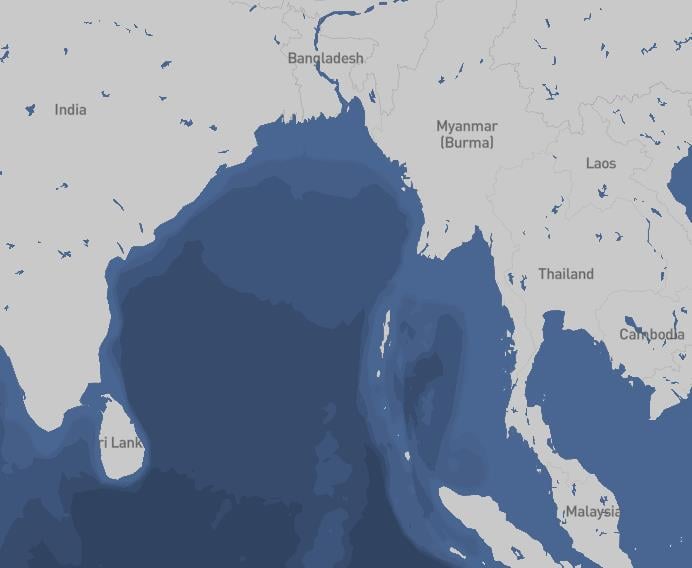
Exposure remains low-frequency but potentially high-impact across the Bay of Bengal and Andaman Sea: waters between Bangladesh and Myanmar, the Andaman Islands, northern Sumatra, approaches to the Malacca Strait and western Malaysia. The heaviest burden falls after the rescue, while the master, company, flag state, coastal authorities and Protection and Indemnity (P&I) interests establish a place of safety. Exposure runs the other way as well. The duty to render assistance to those in distress is long established in international law, and operators should assume that a failure to respond attracts closer scrutiny than an unplanned deviation.
RECOMMENDATIONS
- Voyage preparation: Brief masters and bridge teams on movement corridors and the likelihood of small, overloaded or unlit craft. Treat late September to March as elevated, without assuming the rest of the year is clear.
- Enhanced lookout: Maintain radar and visual watchkeeping, particularly at night and in poor visibility. Do not rely on AIS or distress transmissions alone.
- Rescue readiness: Review recovery equipment, first-aid supplies and protective equipment. Confirm current Maritime Rescue Coordination Centre (MRCC) contacts for the Bay of Bengal and Andaman Sea SAR regions before entering the area. Ambrey has Rescue Advised Management Practices, which have been pee-reviewed by the International Maritime Rescue Federation. It is advised to review these measures ahead of coastal transits in these regions.
- Onboard contingency: Plan how rescued people would be accommodated, watered, sheltered and triaged without compromising vessel safety, assuming a group whose circumstances cannot be established onboard.
- Early disembarkation planning: Contact the company, rescue centre, flag state, P&I provider and agents immediately, and plan for responsibility continuing after recovery. The revised IMO/UNHCR/ICS guide is the reference framework.
- Evidence preservation: Record positions, times, communications and observations without delaying rescue or compromising survivors’ dignity.
- Watch land-side indicators: Track conflict, displacement and protection conditions in Rakhine and Bangladesh alongside arrival statistics. Renewed fighting may give earlier warning than interception or destination-country figures.
Frequently Asked Questions
- Why are Rohingya continuing to make dangerous sea journeys from Myanmar and Bangladesh?
Rohingya maritime movement is driven mainly by conditions on land. In Myanmar, conflict, statelessness and restrictions on movement and livelihoods continue to limit prospects for safe return. In Bangladesh, more than 1.2 million Rohingya remain dependent on humanitarian support, with limited access to formal employment, education and permanent status. These pressures create demand for onward movement even when the sea journey is dangerous.
- Where are Rohingya boats travelling, and which maritime routes are most affected?
Malaysia remains a major destination because of family links, an established Rohingya community and informal employment opportunities. Boats commonly depart from coastal areas of Bangladesh and Myanmar and move across the Bay of Bengal and Andaman Sea. Indonesia, particularly Aceh, is also an important rescue and disembarkation location, while Thailand can serve as a transit point.
- What is the difference between migrant smuggling and human trafficking on Rohingya sea routes?
Smuggling generally involves people paying facilitators to cross borders irregularly. Trafficking involves exploitation and may include deception, kidnapping, confinement, extortion or forced labour. A journey can begin as a smuggling arrangement and later become trafficking if passengers lose control over their movement or are exploited. Rohingya maritime networks can involve both practices.
- How do Rohingya sea crossings affect commercial shipping?
The direct impact on scheduled commercial shipping remains limited, but individual encounters can create significant operational demands. A merchant vessel may need to divert, rescue people from the water, provide medical treatment and temporary accommodation, and coordinate disembarkation with coastal authorities. The Bangladesh-flagged M.T. Meghna Pride demonstrated this risk in April 2026 when it encountered nine survivors of a sinking in the Andaman Sea.
- What should merchant vessels do if they encounter a migrant boat in distress?
Masters should maintain effective radar and visual watchkeeping, particularly for small or unlit craft, and should not rely on Automatic Identification System signals or distress calls alone. If a vessel encounters people in distress, the master should follow applicable search-and-rescue procedures, contact the relevant Maritime Rescue Coordination Centre, prepare for recovery and first aid, and coordinate early with the company, flag state, Protection and Indemnity provider and local agents regarding safe disembarkation.
CONTACT INFORMATION
Ambrey: +44 203 503 0320, intelligence@ambrey.com
AMBREY – For Every Seafarer, Every Vessel, Everywhere.