Escalation & Uncertainty in Run-Up to US Midterms
Date issued: 22nd October 2026
This document has been approved for distribution by Ambrey Analytics Ltd.
Senior Analyst at Ambrey, Daniel Mueller stated:
“The maritime security environment across the Strait of Hormuz and the wider Gulf region has deteriorated, driven by intensified Iranian targeting of commercial vessels, continued US naval enforcement operations, and the potential for renewed military escalation. With the number of vessels damaged increasing notably and the threat extending beyond the Strait, the approaching US midterm and Israeli elections introduce additional uncertainty regarding the likelihood of further confrontation. While renewed US airstrikes appear less likely in the immediate pre-election period absent a significant triggering event, the risk of retaliatory action and wider maritime disruption remains elevated. Shipping companies should adopt a heightened-risk posture, reassessing voyage planning, insurance exposure, and maritime security measures to account for the potential for further deterioration.”
EXECUTIVE SUMMARY
- Strait of Hormuz transits remain contested and high risk, although commercial vessels continue to transit daily.
- Shipping remains exposed to the ongoing US–Iran stand-off, with limited prospects for a diplomatic resolution. The number of vessels damaged in Strait of Hormuz-related incidents increased sharply in October.
- Iran threatened to pursue and target vessels transiting the Strait of Hormuz without Iranian authorisation throughout the wider Gulf region, increasing the geographic scope of the maritime threat.
- Incidents attributed to Iran have extended beyond the Strait of Hormuz, with merchant vessels targeted in the Arabian/Persian Gulf and Gulf of Oman, including off Iraq, Oman, Qatar, Saudi Arabia, and the UAE. Vessels transiting the Strait of Hormuz are at elevated risk across the region.
- The risk of further escalation remains elevated ahead of Israel’s election on 27 October and the US midterm elections on 3 November.
- Renewed US strikes remain a key escalation risk, particularly after the US midterms, with potential Iranian retaliation likely to increase the threat to commercial shipping across the wider Gulf region.
SITUATION
Since the expiry of the US–Iran Memorandum of Understanding on 8 July 2026, both sides have remained in a stand-off, with limited prospects for a diplomatic resolution to the conflict. Commercial shipping continues to face significant security risks. Iranian forces have targeted vessels transiting the Strait of Hormuz without Iranian authorisation, while US forces have maintained a naval blockade against Iran, enforced through the use of military force.
In October, the number of vessels damaged in connection with transits through the Strait of Hormuz increased sharply. During the two weeks from 3 to 16 October, the number rose to 11 and 13 vessels per week, respectively, compared with an average of three to four per week in the preceding weeks. This increase coincided with an expansion of Iranian operations aimed at restricting transits deemed unauthorised, while US the continued to facilitated transits along the Omani coastline.
On 9 October, the Islamic Revolutionary Guard Corps (IRGC) threatened to pursue and target vessels transiting the Strait of Hormuz without Iranian authorisation throughout the wider Gulf region. During October, incidents attributed to Iran involved merchant vessels off Qatar, the United Arab Emirates (UAE), Saudi Arabia and Sohar, Oman. Between 8 and 16 October, six merchant vessels – five tankers and one gas carrier – were damaged outside of the Strait of Hormuz. Additionally, a tanker was damaged offshore Iraq on 20 October.
These were the first reported incidents involving merchant vessels outside the Strait of Hormuz since 9 September, when two tankers were struck off Iraq and the UAE. Iran claimed that those attacks were conducted in response to US strikes against Iranian tankers. On 8 September, five Iran-linked tankers were struck by US forces. This followed a separate incident on 5 September, when US Central Command (CENTCOM) announced that US forces had struck three Iranian crude oil carriers in response to Iranian attacks against US naval vessels.
CENTCOM commander Admiral Brad Cooper subsequently issued the following statement: “Let the message to the IRGC be clear: If you shoot at two of our ships, we will impose an even higher economic cost – taking out three of yours. We will not hesitate to defend American forces, and if necessary, destroy Iran’s limited and exposed oil fleet.”
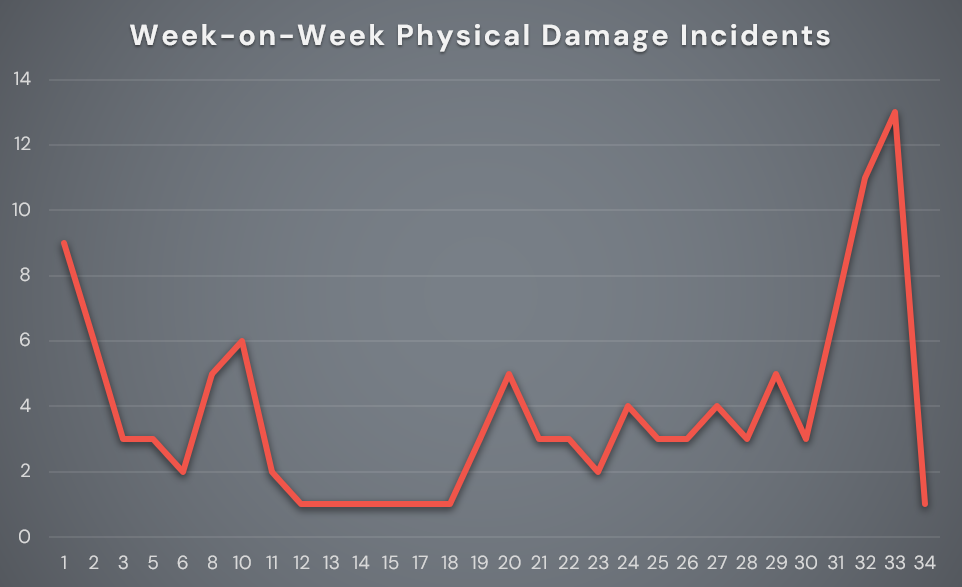
Week-on-week comparison of physical damage incidents related to Iranian kinetic action since the war began
Threat Update
The October increase in attacks appears to reflect an effort by Iran to exploit the approaching US midterm elections to increase political pressure on the Trump administration. Reporting citing Iranian officials suggests that Iran has deliberately intensified and adapted its maritime targeting tactics to
influence the 3 November vote, calculating that disruption to shipping and elevated energy prices could increase domestic pressure on the administration to limit or end the war. Iranian political commentary has also portrayed potential Republican losses as an opportunity to constrain future US military action.
The approaching Israeli election on 27 October introduces a further source of uncertainty. Netanyahu faces pressure to maintain his security credentials, while reports indicate that renewed military action against Iran has been discussed in the run-up to the election. Claims that Netanyahu sought strikes specifically for electoral advantage remain contested. Nevertheless, the possibility that either side could escalate for strategic or domestic political reasons increases the risk of further confrontation during this period.
The prospect of renewed US airstrikes also warrants attention. President Trump stated on 8 October that the US would not resume strikes before the midterm elections, while reporting indicates that US forces have been preparing for potential major combat operations.
The likelihood of renewed US airstrikes appears constrained in the immediate pre-election period, absent a significant triggering event, but the possibility remains. Any renewed US strikes could prompt Iranian retaliation against US-linked commercial shipping or expand the geographic scope of maritime targeting. With the last US airstrikes against Iran occurring on 1 September, Tehran has had an extended period in which to adapt its surveillance and targeting methods following earlier strikes.
For shipping companies, the combination of increased attack frequency, an expanded threat area and uncertainty surrounding potential renewed military operations creates a heightened-risk environment. Vessels transiting without Iranian authorisation face an elevated risk of being targeted across the Arabian/Persian Gulf, Strait of Hormuz, and Gulf of Oman. Companies should account for the potential for further deterioration in the security environment when conducting voyage planning, assessing insurance exposure and reviewing maritime security measures.
RECOMMENDATIONS
- American and Israeli flagged, owned and operated shipping is advised to avoid transiting into the Arabian/Persian Gulf until a peace agreement has been announced.
- Other shipping is advised to coordinate Strait of Hormuz transits with military authorities in advance of a planned transit. Operational disruptions or delays remain a realistic possibility even if not directly targeted.
- Crews should be briefed that, even if transit has been coordinated, if they are instructed not to proceed, they should acknowledge the instructions and follow them immediately.
- Shipping proceeding to other regional ports should continue to adopt ship protection measures consistent with the risk of conflict, and should engage an intelligence provider for route planning.
- Companies are recommended to engage an intelligence provider while operating in the region to maintain awareness of threat developments.
Frequently Asked Questions
- What is driving the deterioration in maritime security around the Strait of Hormuz?
The expiry of the US–Iran Memorandum of Understanding on 8 July 2026 has left both sides in a prolonged stand-off, with limited prospects for a diplomatic resolution. Iranian forces have intensified operations against vessels transiting without Iranian authorisation, while the US continues to enforce its naval blockade against Iran. The threat has also expanded beyond the Strait of Hormuz into the wider Gulf region, increasing risks to commercial shipping.
- How has the maritime threat evolved during October?
The frequency of vessel damage increased sharply, with 11 vessels affected during the week of 3–9 October and 13 during 10–16 October, compared with an average of three to four per week in preceding weeks. Between 8 and 16 October, six merchant vessels were damaged outside the Strait of Hormuz. Reported incidents extended to waters off Qatar, the UAE, Saudi Arabia and Sohar, Oman, indicating a broader geographical threat to commercial shipping.
- How could domestic political developments influence the risk of further escalation?
The approaching US midterm elections on 3 November may be influencing Iran’s maritime targeting strategy, with disruption to shipping and higher energy prices potentially intended to increase domestic pressure on the Trump administration. Israel’s election on 27 October adds further uncertainty, amid reports of discussions about renewed military action against Iran. Although immediate renewed US airstrikes appear less likely absent a significant triggering event, preparations for potential operations and the possibility of political or military miscalculation remain important escalation risks.
- What are the implications for commercial shipping, and what precautions should operators take?
Commercial vessels face an elevated risk of attack, particularly when transiting without Iranian authorisation. The threat extends across the Arabian/Persian Gulf, the Strait of Hormuz and the Gulf of Oman, with the potential for further geographic expansion if US strikes resume. Shipping companies should incorporate the deteriorating security environment into voyage planning, reassess insurance exposure, review maritime security measures and prepare contingency plans for further disruption or escalation.
CONTACT INFORMATION
Ambrey: +44 203 503 0320, intelligence@ambrey.com
AMBREY – We Prepare, Support, Respond – For Every Seafarer, Every Vessel, Everywhere.