Key Takeaway
Dr Fang Yang, Asia Maritime Security Analyst highlights the growing maritime security risks associated with North Korea’s accelerating missile-testing programme and its implications for commercial shipping in Northeast Asia:
“North Korea has fired ballistic missiles more than twice as often in 2026 as in 2025, and the launch tempo has accelerated since August. Ambrey assesses the surge marks a shift from developing weapons to deploying, producing and showcasing them, often timed to political pressure points. For shipping, the main effects are unannounced debris risk in the Sea of Japan, rising friction in the Yellow Sea and sanctions exposure from North Korea–Russia trade.”

Executive Summary
Key Developments and Implications for Merchant Shipping
- North Korea carried out at least seven launch events between 3 October and 4 November 2026, four of them from 29 October onwards, including an intermediate-range hypersonic missile and cluster-type warheads.
- By 12 October, Japan counted more than twice as many ballistic launch occasions as in 2025, and about three times as many missiles.
- Most launches involve short-range ballistic and cruise missiles, often fired in salvos and increasingly described as “drills”, which suggests weapons are entering service.
- The likely drivers are a new five-year defence plan (2026–2030) focused on operational deployment and serial production, arms supplies to Russia, signalling around allied exercises and a border dispute with Seoul.
- Maritime risk centres on unannounced launches, mostly into the Sea of Japan but also off North Korea’s west coast, and, in the Yellow Sea, on rising friction near the de facto inter-Korean maritime border and the risk of renewed GNSS jamming.
- Operators should monitor coastal state warnings, strengthen GNSS procedures in the Yellow Sea and tighten sanctions screening on trades linked to North Korea or Russia’s Far East.
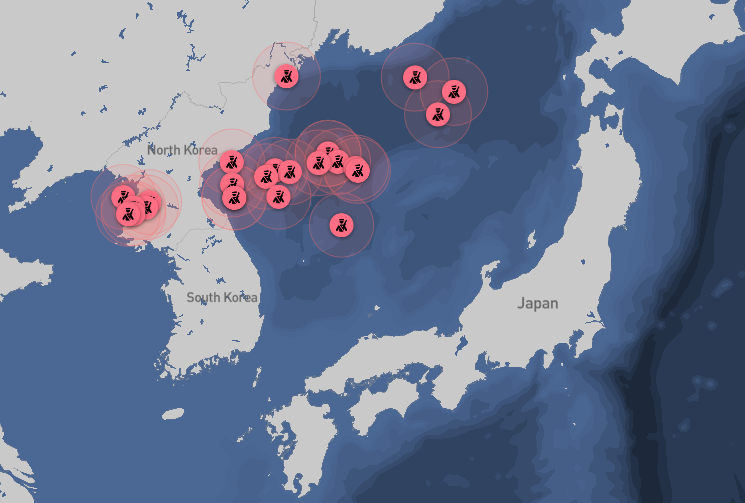
North Korean Missile Launch Timeline: October–November 2026
North Korea carried out at least seven launch events between 3 October and 4 November 2026, four of them from 29 October onwards (Table 1). They included an intermediate-range hypersonic missile, submarine-launched cruise missiles and cluster-type warheads on both a ballistic and a cruise missile.
Table 1. North Korean launch events, 3 October – 4 November 2026
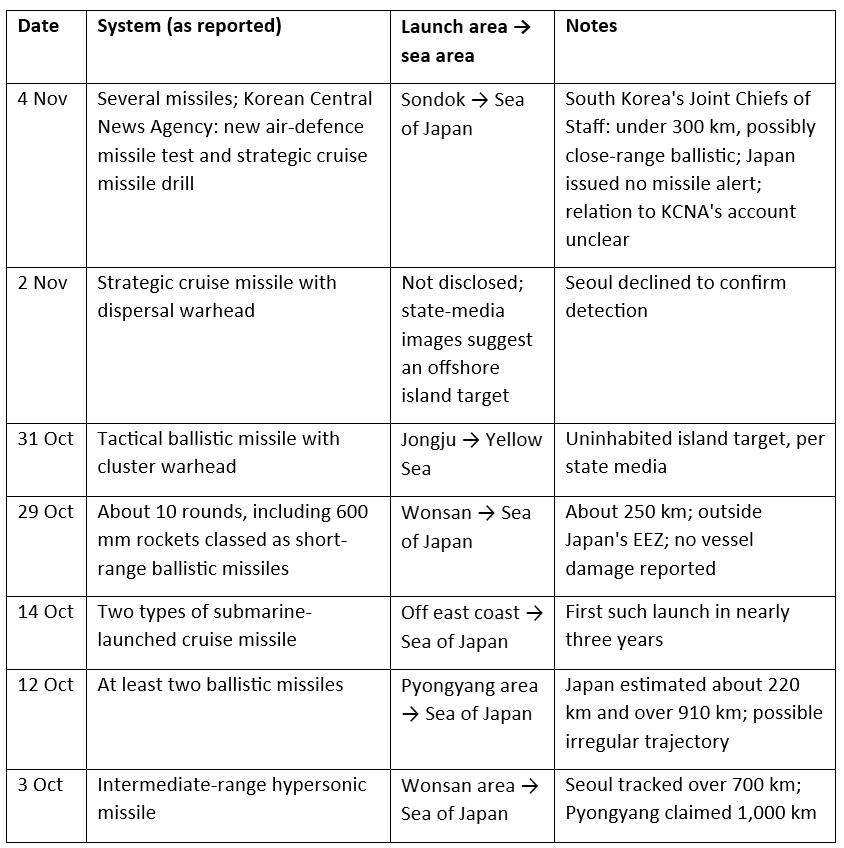
Sources: Japan’s Ministry of Defense; South Korea’s Joint Chiefs of Staff; KCNA; media reports.
CONTEXT
North Korea’s Missile Development: From Weapons Testing to Operational Deployment
North Korea’s testing has moved in cycles. After six nuclear tests and its first intercontinental ballistic missile (ICBM) flights by 2017, Pyongyang paused nuclear and long-range tests during the 2018–2019 summits with US President Donald Trump, which broke down over how much sanctions relief North Korea would get for denuclearisation steps.