AMBREY Threat CIRCULAR > INCREASED SOMALI PIRACY ACTIVITY
Date issued: 24 June 2026
This document has been approved for distribution by Ambrey Analytics Ltd.
“Somali Pirate Action Group activity intensified during June, with at least five suspicious approaches reported in the Gulf of Aden alone. The nature of these incidents became increasingly aggressive, with attackers frequently opening fire. Although three merchant vessels were successfully hijacked between 21 April and 2 May, no successful hijackings of transiting merchant vessels were reported thereafter. Particularly the adherence to BMP-MS and embarkation of Private Armed Security Teams reduced the effectiveness of Somali piracy.”
EXECUTIVE SUMMARY
- Two tankers and a general cargo ship highly likely remained under the control of Somali pirate action groups (PAGs).
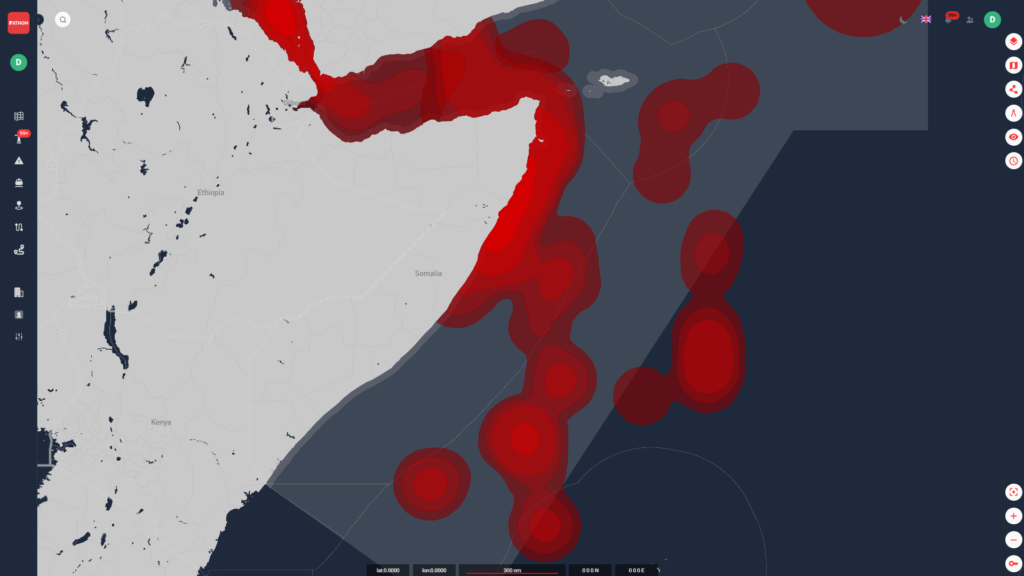
- The vessels are currently held in Somali Indian Ocean territorial seas in known holding areas.
- The vessels were hijacked between 21 April and 2 May 2026, since then no further hijacking occurred.
- Seven suspicious approaches were recorded since the last hijacking, four in the past week alone.
- Approaches increasingly occur along or north of the International Recommended Transit Corridor in the Gulf of Aden. While the threat near Somali waters is not absent, vessels should account for the spread of suspected piracy activity across the Gulf of Aden.
- Prevailing weather conditions in the Indian Ocean likely facilitate the enhanced piracy activity in the Gulf of Aden. The Monsoon Season is set to last until approximately September.
- Somali PAGs continue to operate opportunistically, with recent incidents confirming the known capability.
- Armed security highly likely prevented the hijacking of further merchant vessels.
SITUATION
Since the first successful hijacking of a merchant vessel on 21 April 2026, piracy activity off Somalia and in the Gulf of Aden has evolved from a series of successful hijackings targeting vulnerable vessels to a sustained campaign of suspicious approaches and armed attacks against merchant shipping. Between 21 April and early May, four vessels were successfully hijacked, including two product tankers, a general cargo vessel, and a dhow. These vessels shared common vulnerabilities, including low freeboards (0.8–2.1 metres), slow speeds or anchorage positions, and the apparent absence of embarked armed security teams. Boarding parties typically consisted of six to eleven armed individuals operating from one or more skiffs and equipped with AK-pattern rifles and, in some cases, rocket-propelled grenades (RPGs).