AMBREY INSIGHT> Mediterranean region has entered the High Irregular Migration Season
Date issued: 19 May 2026
“Ambrey’s monitoring of Mediterranean SAR activity is structured around the operational position of the merchant vessel. Over more than four years of continuous data collection, the pattern has remained consistent, a clear seasonal acceleration through the spring and summer. The 2026 figures reflect this pattern. ”
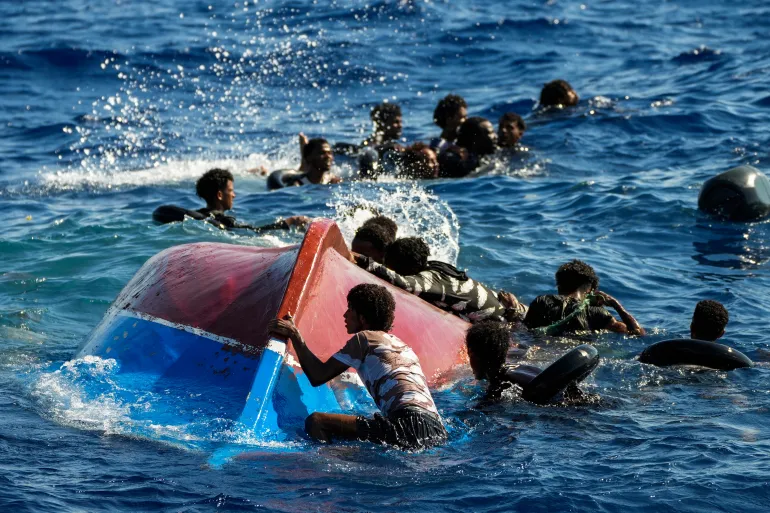
EXECUTIVE SUMMARY
- The wider Mediterranean region has entered the High Irregular Migration Season (HIMS)
- Merchant vessel participated in 30 % of Search and Rescue events detected by Ambrey
- Greece, Libya and the central Mediterranean remain the principal exposure zones for commercial shipping
- Recorded events nearly doubled from February to March
- IOM reported nearly 1,000 Mediterranean migrant deaths already in 2026
- Greek authorities estimate 550,000 people in Libya are intending to cross, and SAR demand on merchant vessels is set to keep climbing through the summer
- Ambrey’s RAMP checklist helps masters prepare. Speak to us about SAR readiness and intelligence-led planning for your fleet
SITUATION: MEDITERRANEAN SAR SEASONALITY: SEABOURNE IRREGULAR MIGRATION IN NUMBERS
Irregular migration in the Mediterranean has entered its heightened seasonal period, and Ambrey’s monitoring of more than four years of SAR activity shows the 2026 figures tracking the same seasonal curve — only steeper.
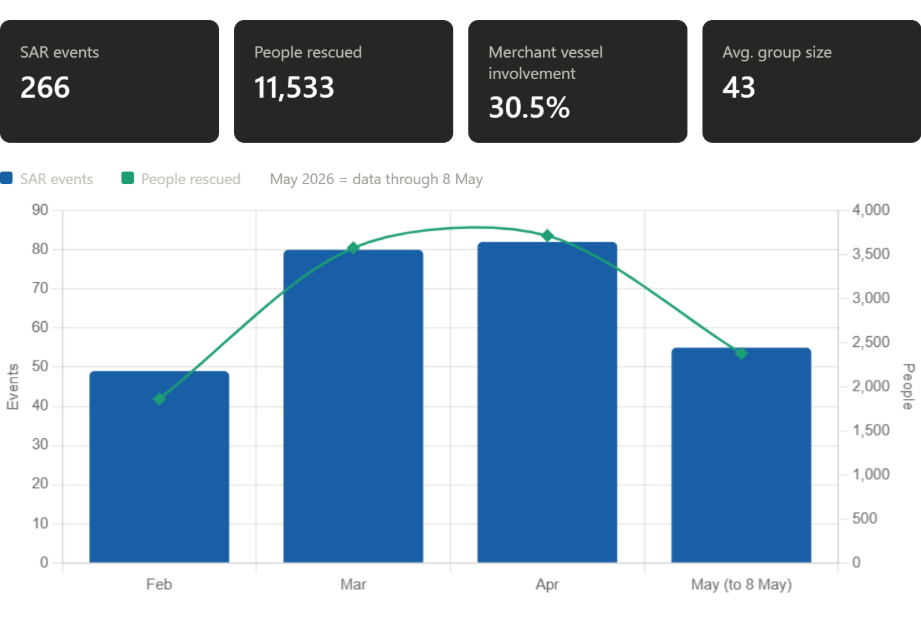
Between February and 8 May 2026, Ambrey recorded 266 search-and-rescue-related events across the Mediterranean and Atlantic migration routes, involving the rescue of more than 11,500 people. Merchant vessels were directly involved in 30.5% of these events (81 in total) confirming that roughly one in three rescue events results in a merchant vessel being drawn into the operation.
The seasonal acceleration is clearly visible in the data. Recorded events more than doubled between February and March, with people rescued rising from 1,862 to 3,577 (+92%). Activity remained at that elevated level through April (82 events, 3,716 people rescued). May has opened at a notably higher daily pace, 55 events in the first eight days alone, equivalent to two-thirds of April’s full-month total in under a third of the month. If that pace holds, May will materially exceed both March and April.
Average group size has remained broadly stable at 43–45 people per migrant craft, so the increase in people rescued is driven by event volume rather than larger boats, meaning each additional event carries the same operational and humanitarian load for the responding vessel.
WHERE MERCHANT VESSELS ARE MOST EXPOSED
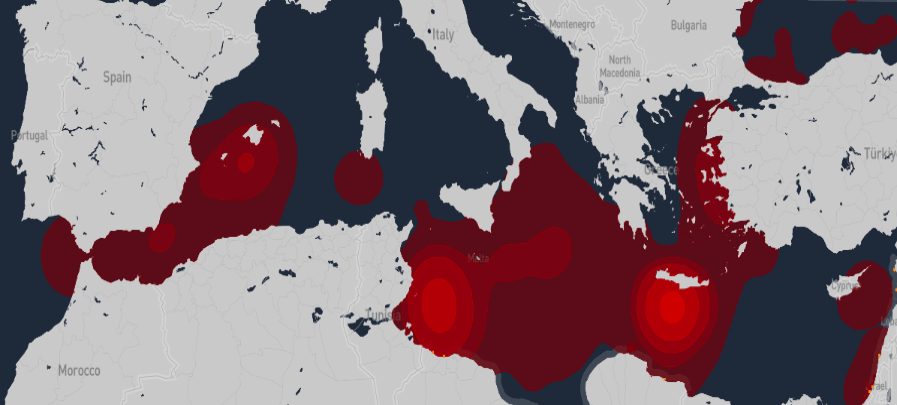
The geographic distribution underlines where masters should expect tasking:
- Greece — 77 events, 4,078 people rescued. The single largest concentration, and the area with the highest merchant-vessel involvement rate (75% of Ambrey-recorded Greek SAR events drew in commercial shipping).
- Libya — 65 events, 2,694 people rescued. Departures continue from both eastern and western Libya despite increased European pressure on Libyan authorities to monitor and prevent crossings.
- Central Mediterranean (Libya, Tunisia, Malta, Italy combined) — 91 events, 3,871 people. Held flat month-on-month at ~24 events/month, indicating sustained pressure rather than a clear seasonal spike.
- Atlantic route to the Canary Islands — 23 events, 1,454 people. Overall numbers are down compared with prior seasons. Still, Ambrey has recorded a notable uptick in rescues off the West African coast (Senegal, Gambia, Western Sahara) in May, involving migrant craft attempting the Canaries crossing. This is an early indicator worth watching.
THE WIDER CONTEXT — A DEADLY YEAR, HALF A MILLION WAITING
The humanitarian context has deteriorated sharply. According to the IOM, at least 990 deaths had been recorded across the Mediterranean by early April 2026, one of the deadliest starts to a year since records began in 2014, with the Central Mediterranean route alone accounting for the majority of fatalities.
On 10 May 2026, Greek Migration Minister Thanos Plevris stated that an estimated 550,000 migrants and refugees are currently in Libya awaiting an opportunity to cross to Europe, a figure that, even if only partially realised over the coming months, points to sustained or escalating SAR demand through the summer season.
European governments, particularly Greece, Italy and Spain, have continued to press North African authorities to expand interdiction and monitoring. To date, that pressure has not visibly reduced departures from either eastern or western Libya. Ambrey has also recorded an incident in which an NGO vessel conducting rescue operations off western Libya was reportedly fired upon by a western Libyan SAR vessel, a reminder of the security complexity in the area and the unpredictability of state and quasi-state actors involved in coastal SAR.
THE OPERATING ENVIRONMENT FOR MASTERS
Masters tasked in the Mediterranean face a uniquely complex operating picture, with multiple actors — NGOs, dedicated SAR vessels, national coast guards, and MRCCs, that do not always share the same operational priorities or interpretation of responsibilities. This has translated into real-world pressure on merchant mariners.
Ambrey has recorded incidents in which merchant vessels were likely issued unlawful or inappropriate instructions following a rescue, including being compelled to sail with rescued persons outside the SAR zone in which the rescue took place. Such situations place masters in a difficult position, balancing:
- Obligations under SOLAS and UNCLOS
- The immediate safety of rescued persons
- The security of the vessel and crew
- Instructions issued by coastal authorities or MRCCs
- Potential for reputational damage for the vessel owner/operator
The combination of high rescue volumes, ambiguous tasking, and a deteriorating safety environment on the water means SAR involvement is now a near-routine operational risk for vessels transiting the Mediterranean during the high season — not an exceptional event.
Outlook and Assessment
- It is assessed as highly likely that irregular migration activity, and consequently SAR demand on merchant vessels, will continue to rise over the coming weeks and months in line with the established seasonal pattern. The combination of stable weather windows, a backlog of intending migrants in Libya, and continued NGO and coast guard activity points to sustained or increasing tasking of commercial shipping through the summer.
- Areas of highest expected merchant-vessel exposure: Greek waters (particularly south of Crete), western and eastern Libyan SAR zones, the central Mediterranean, and — as an emerging watch item — the West African coast off Senegal, Gambia and Western Sahara.
Ambrey’s RAMP checklist — preparing crews before the call comes
Ambrey developed its Rescue Advice Management Practice (RAMP), peer reviewed by the International Maritime Rescue Federation, a checklist specifically for this operating environment. Drawing on four-plus years of SAR event monitoring and direct merchant-vessel engagement data, RAMP supports masters and operators in preparing for rescue operations in a way that protects the safety, security and legal position of both the vessel and the people rescued.
In an environment where 30%+ of recorded SAR events involve commercial shipping, where tasking can be ambiguous, and where 2026 is already trending as one of the deadliest years on record, preparation is no longer optional.
Masters should expect further SAR taskings and ensure crews are confident in rescue procedures, post-rescue decision-making, communications protocols, and escalation pathways.
Ambrey’s multi-source monitoring gives operators the situational awareness to anticipate rather than react. That intelligence-led approach is what reduces risk for both the rescuers and the rescued.
CONTACT INFORMATION
Ambrey: +44 203 503 0320, intelligence@ambrey.com
AMBREY – For Every Seafarer, Every Vessel, Everywhere.