AMBREY INSIGHT> Cross-Belligerent Escalation in the Direct Targeting of Merchant Vessels
Date issued: 01 June 2026
“It is highly likely that strikes against merchant vessels will continue in Black Sea waters, where direct targeting is now an established feature of the conflict. The arrival of more permissive weather and calmer sea states, historically a driver of intensified unmanned-system activity, makes it likely that the operational tempo will remain high through the season.”
Source: This document has been approved for distribution by Ambrey Analytics Ltd.
EXECUTIVE SUMMARY
- Six merchant vessels were directly targeted across the Black Sea within a 24-hour window on 28–29 May 2026
- Three vessels were struck by Ukrainian unmanned surface vehicles (USVs) inside the Turkish EEZ; three were struck by Russian unmanned aerial vehicles (UAVs) in the Ukrainian maritime corridor off Odesa.
- All three Turkish-EEZ targets were tankers assessed as linked to Russian-origin hydrocarbon exports, at least two carried on Ukrainian war-sanctions listings.
- At least two USVs failed to detonate on impact during a ship-to-ship (STS) operation, almost certainly a malfunction, leaving uncontrolled craft adrift and prompting a Turkish exclusion zone.
- A Russian UAV struck the bridge and accommodation block of a Vanuatu-flagged vessel off Odesa, injuring two crew, indicating intent to inflict casualties, not merely disable
- Ukraine has resumed strikes inside Turkish waters after a diplomatically driven pause, signalling renewed intent to act well outside the recognised conflict zone.
- Ambrey continues to record unexploded ordnance and drifting unmanned craft (USVs, UAVs, sea mines) washing ashore across non-JWLA Black Sea littoral states.
- The threat to merchant traffic in non-JWLA Black Sea waters — Romanian, Bulgarian, Turkish and Georgian EEZs, is assessed as ELEVATED and likely to persist through the summer operating season.
SITUATION
The 48 hours spanning 28–29 May 2026 marked a significant escalation in the maritime dimension of the Russia-Ukraine conflict. Although attacks against ports and port infrastructure persisted throughout May, direct targeting of merchant vessels had decreased markedly in the preceding weeks. The events of 28–29 May reversed that trend abruptly and pointed to a notable shift in operational behaviour by both belligerents.
Ambrey recorded 15 vessels suffering physical damage across the Black Sea in May 2026 alone. The 28–29 May cluster accounted for six of these in a single 24-hour period.
The escalation began with Ukrainian attacks against three merchant vessels operating in Turkish waters. The vessels were linked to the transportation of Russian hydrocarbon exports, with two of the vessels understood to be sanctioned. The vessel JAMES II was reportedly struck by an USV. Additionally, the vessels ALTURA and VELORA were targeted during a ship-to-ship (STS) operation after ALTURA had suffered an earlier USV attack incident in March.
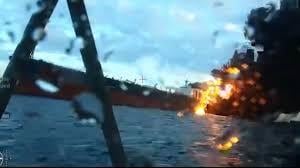
Footage published following the incident with ALTURA and VELORA showed that at least two of the USVs involved in the attack malfunctioned and failed to detonate during the STS operation. Shortly thereafter, the Turkish Coast Guard reportedly established an exclusion zone in the area and was likely involved in efforts to secure or remove the malfunctioning crafts.
Visual evidence circulating indicated that the USVs were likely Ukrainian MAGURA V5 systems, which are assessed capable of carrying payloads of up to approximately 300 kilograms.
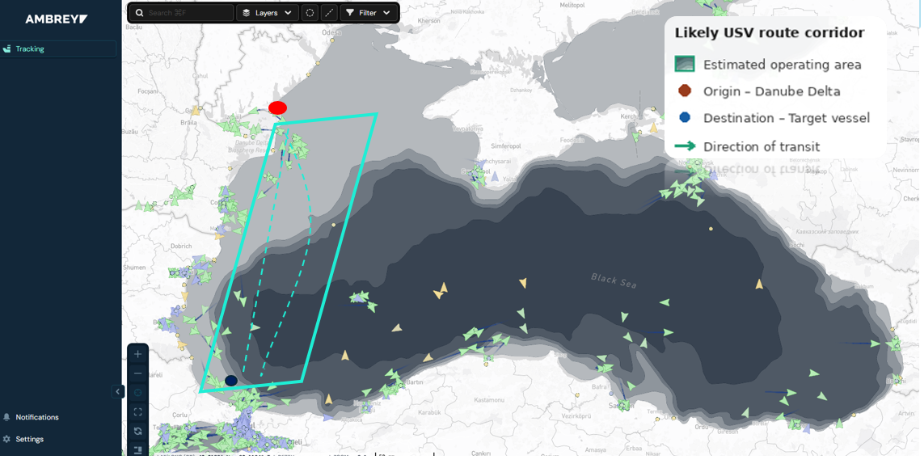
Separate footage also emerged online showing a USV transiting through Turkish waters, highly likely filmed by mariners aboard an unrelated merchant vessel. The exact location of the footage is yet to be determined.
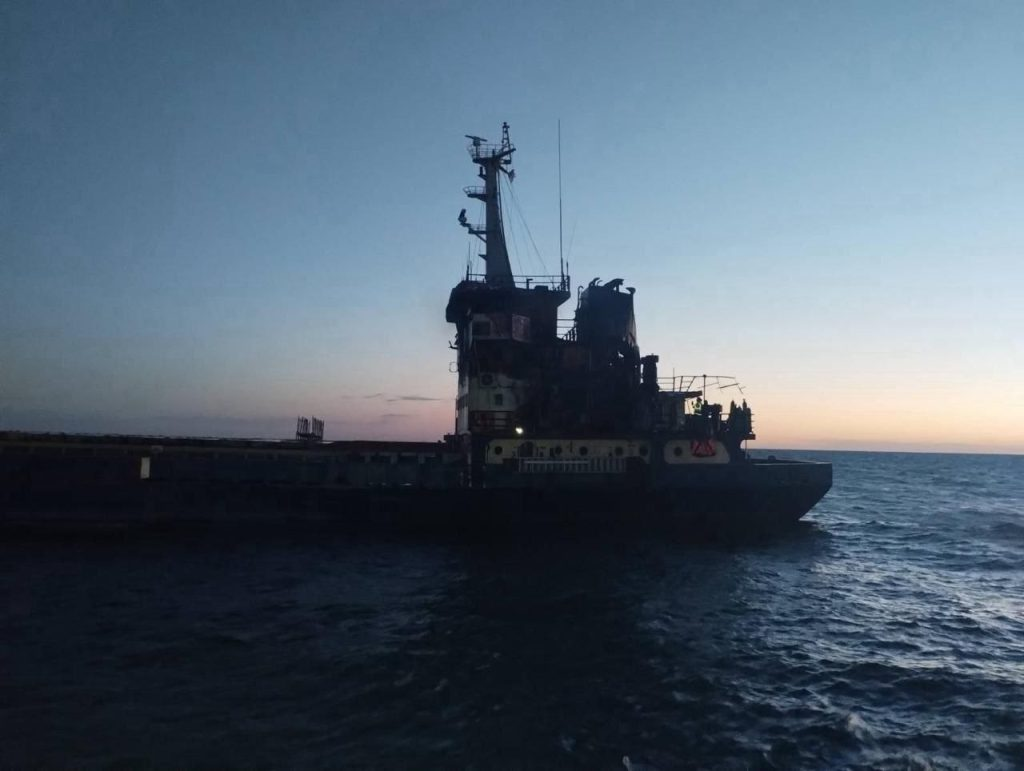
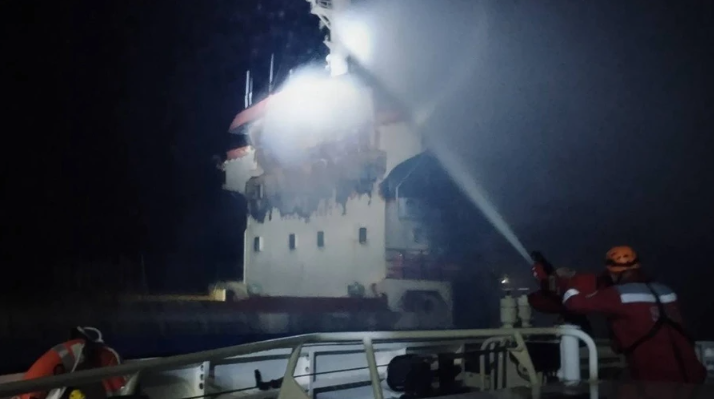
Within less than 24 hours of the incidents in Turkish waters, Russian forces responded with attacks against three merchant vessels outbound from Ukraine. Vanuatu-, Panama-, and Comoros-flagged vessels were targeted. Ukrainian officials subsequently released imagery of the damage sustained by the Vanuatu-flagged vessel, which indicated that the UAV strike impacted the bridge and accommodation block. The location of the strike indicated that the intent was not solely to disable the vessel, but also likely to inflict casualties among the crew. Two marines were reportedly injured.
CONTEXT
Ambrey assessed earlier in 2026 that the arrival of spring and summer, together with increasingly permissive weather and sea states, would likely drive an increase in unmanned system use by both belligerents. This pattern has held consistently across the last three years of the conflict, in which calmer conditions have historically enabled a higher tempo of USV, UAV and hybrid strike operations. The May 2026 spike is consistent with that seasonal curve.
These developments coincide with significant change along the onshore frontlines. While Russian forces have lost access to certain Starlink terminal capabilities and therefor continued to rely on more traditional weapon systems, Ukraine has continued to develop unmanned-warfare technology rapidly, including AI-assisted targeting, expanded domestic production, and more sophisticated long- and mid-range strike systems. Collectively these have improved the effectiveness, range and operational complexity of Ukrainian unmanned operations, some able to reach targets up to 2,000km away. Ukrainian targeting has remained heavily focused on Russian hydrocarbon infrastructure, refineries, ports, pumping stations and associated logistics — with the May dataset showing repeated strikes on Novorossiysk, Tuapse, Taman and Kavkaz.
ANALYSIS
For merchant vessels, the 28–29 May events represent a material elevation in threat. Operations inside the Joint War Listed Area (JWLA-033) covering Russian and Ukrainian waters have long carried recognised heightened risk. Operations outside the JWLA, in Romanian, Bulgarian, Turkish and Georgian waters, have generally been perceived as mostly unimpacted environments. The repeated strikes inside the Turkish EEZ break that assumption and confirm the conflict is increasingly spilling beyond its traditionally recognised high-risk zones.
The malfunctioning and drifting USVs compound the hazard. Footage confirmed at least two craft failed to detonate and were left adrift in frequently used sea lanes. Because these waters fall outside the JWLA, it is a realistic possibility that many vessels are operating with a lower security posture and reduced alert state than they would maintain in Ukrainian or Russian waters — precisely where a drifting, armed and uncommanded craft is most dangerous.
Ukrainian forces are also known to deploy USVs in groups to improve strike probability, which inherently increases the number of disabled or uncommanded systems left adrift after each engagement. This is further compounded by the continued presence of unexploded ordnance, sea mines, USVs and UAVs, drifting across the Black Sea. Ambrey continues to record ordnance washing ashore across multiple non-JWLA littoral states, underlining the persistent and expanding spillover risk. Additionally, GPS and AIS denial and disruption remain persistent issues across much of the Black Sea due to the extensive use of electronic warfare systems.
OUTLOOK
It is assessed as likely that attacks against merchant vessels will continue in the near term. Ukraine has previously struck vessels in Turkish waters before pausing under diplomatic pressure from Türkiye; the latest incidents indicate renewed intent to target maritime assets outside the immediate conflict zone in pursuit of broader objectives against Russian hydrocarbon exports and shipping. Russia’s rapid, casualty-oriented retaliation off Odesa suggests a tit-for-tat dynamic that raises the baseline risk to all merchant traffic in the basin.
- It is assessed as highly likely that direct targeting of merchant vessels will continue, with both belligerents demonstrating willingness to strike commercial shipping linked to the opposing side’s trade.
- It is assessed as almost certain that the spillover effect of the conflict will continue to impact vessel operations in the wider Black Sea
- Primary-exposure areas: the Ukrainian maritime corridor off Odesa and Russian water near Novorossiysk, Secondary exposure areas: Turkish EEZ (particularly loitering areas off Istanbul, Yalıköy and Samsun), Tertiary exposure areas: the Danube-Delta-to-Bosphorus transit corridor through Romanian and Bulgarian waters.
- Drifting unexploded USVs/UAVs and sea mines will continue to represent an indiscriminate, persistent hazard to traffic across the wider basin, independent of any individual vessel’s risk profile.
RECOMMENDATIONS
Ambrey assesses it would be prudent and proportionate to :
- Commission asset screening assessments for both Ukrainian and Russian targeting profile
- Commission a dynamic voyage threat assessment for every Black Sea call, the threat picture is shifting daily and a static assessment will quickly become outdated
- Maintain a heightened alert state and enhanced visual/radar lookout even outside the JWLA
- Brief crews to report and give wide berth to any small, low-profile surface craft or drifting object; a malfunctioning but armed USV remains lethal and may detonate on contact.
- Establish clear communications and escalation protocols with the CSO, local coast guard and the security provider before entering the area.
- Designate and brief a Safe Muster Point (SMP) for UAV/USV attack: above the waterline, amidships and low in the superstructure. The Odesa strikes hitting bridge and accommodation reinforce that crew survivability depends on mustering away from these high-value aim points.
- Pre-position firefighting and casualty-response readiness appropriate to a superstructure strike; the Vanuatu-flagged incident produced a containable accommodation-block fire that was extinguished promptly
- Consider physical hardening of the bridge and accommodation block. (e.g. ballistic blankets, fragmentation mitigation)
CONTACT INFORMATION
Ambrey: +44 203 503 0320, intelligence@ambrey.com
AMBREY – For Every Seafarer, Every Vessel, Everywhere.