AMBREY INSIGHT> Asia Energy Security: Strait of Hormuz Disruption Drives Regional Supply Controls and Shipping Risk
Date issued: 12 March 2026
“Asia’s energy markets are facing a Strait of Hormuz disruption that has moved beyond a price shock into a supply problem. Governments across the region are responding with export restrictions, price caps, reserve releases, and legal supply controls. For shipping and cargo operations, the result is tighter routing, higher costs, and less flexibility across regional trade lanes.”
Source: This document has been approved for distribution by Ambrey Analytics Ltd.
EXECUTIVE SUMMARY
- Asia’s energy risk has shifted from a cost problem to a delivery problem, as Strait of Hormuz disruption reduces cargo transit confidence and degrades schedule reliability across the region.
- Recent projectile strikes on Thai- and Japan-linked vessels show that the disruption is now an immediate security risk for merchant shipping, not only a pricing and insurance shock.
- Gulf route uncertainty, tighter war-risk cover, and a sharp rise in freight costs are forcing Asian buyers to seek alternative supply sources, often over longer routes and at higher delivered cost.
- Governments across the region have moved beyond monitoring into active intervention, deploying export restrictions, price caps, legal supply controls, and emergency reserve mechanisms to shield domestic markets.
- In Northeast Asia, China is restraining outbound product flows to protect domestic stability, while Japan and South Korea are managing inbound supply risk through partial reserve release and price controls, respectively.
- China is reportedly exploring a narrow channel with Iran to keep selected China-linked cargoes moving through Hormuz, but no agreement has been confirmed, and the limited vessel evidence so far does not make it operationally reliable.
- In South Asia, India faces the broadest simultaneous exposure — across gas, LPG, and crude — with emergency legal controls already in force and a time-limited US waiver on Russian crude imports serving as the most critical near-term policy variable.
- In Taiwan, near-term LNG cover is largely in place, though prolonged disruption would raise procurement costs and increase spot cargo competition.
- In Southeast Asia, Thailand has suspended fuel exports under emergency legislation, Malaysia is intensifying port inspections as diverted vessel traffic rises, and Singapore is absorbing sharp price increases across all bunker fuel grades.
- Shipping operators are advised to secure bunker stems ahead of standard lead times, maintain heightened documentation and compliance standards at Southeast Asian ports, and monitor India’s crude waiver renewal and G7 reserve release coordination as the near-term policy triggers for regional supply.
CONTEXT
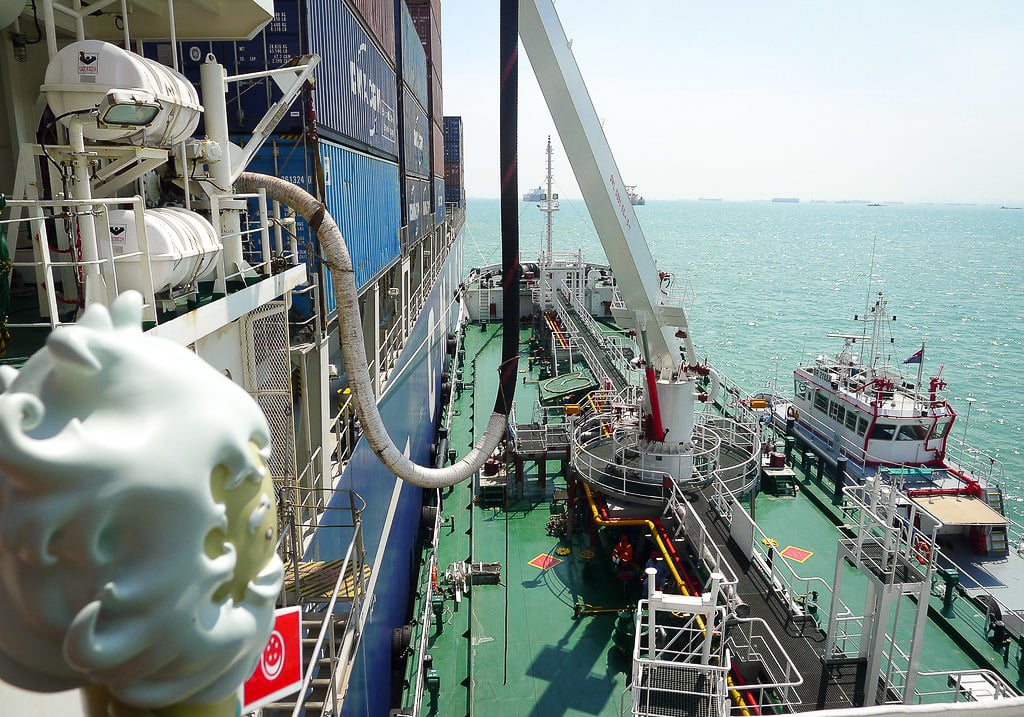
Since the conflict escalated, tanker movements through the Strait of Hormuz have fallen by around 90–97%. Major container carriers and many tanker owners have suspended Gulf transits. War-risk cover has tightened: some insurers have cancelled cover, while available cover is increasingly repriced on a voyage-by-voyage basis at higher premiums. The approach lanes to terminals at Ras Tanura, Ras Laffan, and Jebel Ali are now treated by many operators as a conditional operating area. Recent attacks on Asia-linked vessels highlight the risk. On 11 March, projectiles struck the Thai-flagged Mayuree Naree in the strait and damaged the Japan-linked ONE Majesty near UAE waters, showing that the threat now extends directly to ships tied to Asian trade.
Asia is disproportionately exposed. Unlike Europe, which has pipeline alternatives and shorter Atlantic routes, Asian buyers depend almost entirely on seaborne Gulf supply for crude, LNG, and LPG. When confidence in Hormuz transit falls, the effects spread quickly across Asia’s energy chain: crude imports, LNG schedules, refined product supply, and bunker markets all come under pressure. Alternative origins exist — West Africa, the United States, Australia — but they add significantly to sailing distances and freight costs and cannot be mobilised quickly enough to absorb a sudden volume loss.
Governments across the region are trying to prevent an external shock from becoming a domestic inflation and supply crisis. The response is consistent: protect household fuel prices, secure critical energy supplies, and prepare reserve mechanisms for a disruption that may last weeks rather than days.
Against this backdrop, policy responses are diverging by sub-region and increasingly shaping operational outcomes for shipping. A further uncertainty is whether narrow political exceptions might emerge inside an otherwise restricted operating environment. Reuters reported that China has held talks with Iran over safe passage for crude and Qatari LNG vessels, but neither Beijing nor Tehran has confirmed any agreement. At present, the evidence supports only a limited arrangement for selected China-linked or China-bound cargoes, not a broader reopening of the strait.
ANALYSIS
China: tighten exports, manage prices, and test a narrow Hormuz passage arrangement
Beijing’s response goes beyond a forward-looking export ban. Refiners have been told to pursue cancellations of already signed agreements, not just halt new ones — a more aggressive posture than the initial headlines suggested. Most March cargoes are too far advanced to reverse, so the practical tightening will be felt from April, but the intent signals Beijing is treating this as a sustained rather than temporary measure. Exceptions exist for bonded bunkering and aviation supplies, preserving some continuity in those segments.
The regional consequence is straightforward. China has historically served as a swing supplier of diesel and jet fuel across Asia. As those volumes tighten, import-dependent markets lose a key buffer against price spikes. At the same time, China raised regulated retail fuel price caps by the largest margin in four years — gasoline up approximately USD 101 (695 yuan) per metric tonne and diesel up approximately USD 97 (670 yuan) per metric tonne— accepting a degree of domestic price pass-through rather than absorbing the full shock through state firms.
China’s second line of effort is diplomatic rather than commercial. Beijing has reportedly held talks with Iran over safe passage for crude oil and Qatari LNG vessels through Hormuz. If any understanding emerges, it is more likely to protect China-bound energy supply than Iranian cargoes alone. The inclusion of Qatari LNG in the reporting suggests that any arrangement would be defined by destination and political relationship, not simply by cargo origin.
That said, the operational evidence remains thin. Lloyd’s List Intelligence reported that only a small number of China-linked vessels had transited Hormuz during the first week of March, and none were tankers. Chinese-linked bulk transits, therefore, do not yet demonstrate a reliable safe-passage model for crude or LNG shipping. In practical terms, this means charterers should treat any China-linked arrangement as a possible political exception, not a reliable routing assumption.
Client takeaway: Expect tighter regional product markets and higher bunker-linked costs, even as China avoids domestic shortages. Any China–Iran passage understanding, if it materialises, is more likely to protect selected China-bound energy cargoes than to reopen Hormuz for normal commercial traffic.
Japan: release reserves and reinforce LNG resilience
Japan’s structural vulnerability to this disruption is significant: the country sources approximately 95% of its crude from the Middle East, with around 70% transiting the Strait of Hormuz. Tokyo has now moved beyond preparation to action. On 11 March, Prime Minister Sanae Takaichi said Japan would release part of its reserves from 16 March, including 15 days of private-sector stocks and one month of national reserves. This now sits within a wider International Energy Agency (IEA)-led emergency release that may total 400 million barrels globally, with Japan expected to contribute about 80 million barrels. Despite holding 254 days of emergency reserves, among the largest buffers in Asia, Japan is still weighing how far to move ahead of, or alongside IEA coordination.
On LNG, Japan has an existing emergency arrangement with QatarEnergy and JERA, a major Japanese LNG buyer, that can help support LNG supply if the regional spot market becomes tighter and more competitive.
Client takeaway: Japan is unlikely to face a sudden physical shortage in the near term, but it will remain cautious on routing and may shift to longer-haul supply chains, increasing tonne-miles and schedule complexity. The more immediate issue is not whether reserves will be used, but how quickly the release reaches the market and whether it can meaningfully offset the disrupted Gulf supply.
South Korea: fuel price cap and tighter market governance
South Korea has moved beyond guidance into direct market intervention, imposing a domestic fuel price cap for the first time in nearly 30 years. With approximately 208 days of reserve cover, the country is better buffered than most, but the policy focus has shifted to limiting economic pass-through rather than managing inventory. For shipping, the key point is simple: even strong stocks can still create disruption if delayed cargoes affect refinery planning. In a price-capped market, that pressure can then appear as local tightness and firmer domestic allocation.
Client takeaway: South Korea’s stock position is comfortable, but the price cap shifts the risk from supply to compliance and allocation. Operators with South Korean counterparties should watch for tighter domestic distribution controls if inbound cargo delays persist.
India: emergency governance steps as gas, LPG, and crude pressures compound
India faces the broadest near-term exposure among the focus markets. The supply math for LPG is particularly exposed: the country relies on imports for roughly two-thirds of its LPG consumption, with the vast majority of that volume originating in the Middle East and almost none reaching India by any route other than through the Strait of Hormuz. Storage buffers cover less than two weeks of national demand. Commercial shortages have already been reported in some cities. The government has responded by invoking the Essential Commodities Act and issuing the Natural Gas Supply Regulation Order 2026, which prioritises households, transport fuel and LPG production, while cutting supplies to lower-priority users, including refineries and industrial consumers.
The crude picture carries its own logic. India’s Hormuz crude exposure climbed to approximately 52% of imports in early 2026 — up from 41% in 2025 — partly because refiners had been reducing Russian purchases under commercial and diplomatic conditions tied to the US-India trade deal. That shift left India more exposed at precisely the wrong moment. Indian refiners have since moved quickly to buy prompt Russian barrels under a 30-day US waiver, with reporting now indicating purchases of 20–30 million barrels. Non-Strait supply now covers roughly 70% of the current crude intake. The key issue is the waiver itself: if it expires without renewal while Hormuz flows remain constrained, India’s crude buffer will narrow again with little warning.
Client takeaway: India is the most likely market to show short-term industrial effects — curtailment, fuel switching, and sector prioritisation. Watch the US Treasury waiver renewal as a near-term trigger for crude risk.
Taiwan: secure near-term LNG cargoes and protect power confidence
Taiwan’s near-term LNG position is more secure than the broader regional picture might suggest. The government has confirmed that procurement for March and April is nearly complete, with the final cargoes under active negotiation and expected to close shortly. Qatar accounts for roughly one-third of Taiwan’s LNG supply, which concentrates some origination risk, but the remaining volume is sourced from a range of other suppliers that are not directly affected by the Strait of Hormuz closure. If the situation deteriorates, Taipei has prepared a sequenced fallback: first diverting contracted cargoes from the United States and Australia, then drawing on coordinated arrangements with Japan and South Korea, and only then turning to the spot market. Emergency coal-fired generation is not expected to be needed in April under the current supply outlook.
Client takeaway: Stable through April, but prolonged disruption would raise procurement costs and increase competition for spot cargoes.
Southeast Asia: Thailand export suspension and Singapore bunkering stress
Thailand has moved more decisively than any other Southeast Asian government. The Prime Minister invoked emergency fuel legislation dating from 1973 to suspend exports of all major refined fuel grades and LPG until further notice. The order is not a blanket ban — pipeline exports to Laos and Myanmar and bonded re-exports in free zones are exempt — but it locks domestic supply in place while the disruption persists. Traders must also build domestic stocks to 1.5% of output by end-March, rising to 3% by end-April. Enforcement is active, with arrests recorded at land border crossings within days of the order taking effect.
Thailand’s measures are the most directive in the sub-region, but operational pressure is spreading. Malaysia’s Transport Minister announced a package of port mitigation measures, including clearing empty containers to prevent congestion and conducting more thorough inspections on containers without a confirmed destination, as rerouted vessel traffic increases pressure on Malaysian ports.
Where Thailand and Malaysia are managing supply and logistics, Singapore’s pressure is entirely through price. HSFO has risen more than 40% since the conflict began, with LSFO and VLSFO each up approximately 30%, meaning cost stress spans all grades and vessel types. Conditions have tightened further, with Singapore bunker premiums reaching record highs and some vessels struggling to refuel on schedule. The Energy Market Authority has flagged the risk of higher consumer energy bills if elevated fuel costs persist into contract renewal cycles. At the same time, reports indicate that more Southeast Asian refineries have started cutting output because tighter crude supply is already feeding through, increasing the risk of a smaller regional product pool.
Client takeaway: Thailand’s export suspension reduces the regional product pool. Malaysia’s port measures are likely to add clearance time and documentation scrutiny for vessels calling at Malaysian ports. Singapore’s bunker market faces further cost increases and tighter prompt availability across all grades.
IMPLICATIONS
Voyage reliability and vessel security will remain the central operational problems. War-risk cover is now tighter and more expensive and is often approved on a voyage-by-voyage basis, adding cost unpredictability on top of already elevated freight rates. The latest strikes on Thai- and Japan-linked vessels show that operators now face not only delay and cost escalation, but also an active threat to hull, crew, and cargo. Expect continued anchoring, diversions, late decision points, elevated demurrage costs, and scheduling disputes for the foreseeable future.
Domestic protection policies are shrinking the regional product pool. China’s export restraint and Thailand’s suspension remove key swing volumes. Import-dependent Southeast Asian markets face tighter supply, while price caps elsewhere increase fiscal pressure and may accelerate domestic allocation measures if the disruption extends.
A narrow China-linked passage arrangement would not materially change the wider shipping picture. Even if Tehran quietly permits selected China-bound cargoes — including some third-country energy cargoes such as Qatari LNG — this would remain a selective political exception rather than a restoration of navigational confidence. For the broader market, Hormuz would still function as a highly constrained corridor.
India’s simultaneous exposure across gas, LPG, and crude makes it the highest near-term risk market in the region. Formal statutory controls, sector-level gas allocation, and active crude contingency management are all running in parallel. The 30-day US Treasury waiver on Russian crude is the single most time-sensitive policy variable — its expiry without renewal would tighten India’s crude buffer and narrow regional supply flexibility.
Inspection and enforcement intensity is rising across Southeast Asia. Thailand’s export ban is being enforced at land and sea borders. Malaysia’s port authorities are tightening documentation checks on rerouted vessels and clearing empty containers to ease congestion from diverted traffic. Operators should expect longer port turnaround times, stricter documentation requirements, and greater destination scrutiny across the sub-region.
Rising costs across HSFO, LSFO, and VLSFO increase the value of early stem planning. Tighter fuel oil balances and feedstock stress across Asia may also drive extra spot tanker demand at a time when supply is already constrained. Singapore bunkering remains the most immediate market watchpoint for shipping clients.
RECOMMENDATIONS
- Bunker planning: Secure HSFO, LSFO, and VLSFO stems ahead of standard lead times given Singapore prompt availability constraints.
- Voyage and routing: Build contingency routing and extended scheduling windows into Gulf-proximate voyages; confirm war-risk cover terms before fixture.
- Documentation and compliance: Verify cargo destination documentation and container clearance status for vessels calling at Malaysian ports, and chain-of-custody documentation for fuel cargoes transiting Thailand, where export enforcement has intensified.
- Cargo and counterparty exposure: Flag India-linked gas and LPG cargoes for priority monitoring; review force majeure clauses on contracts with Indian and Northeast Asian counterparties.
- China-linked cargoes: do not assume any reported China–Iran passage understanding is automatically applicable to your vessel or cargo. Treat any such channel as cargo- and relationship-specific unless formally confirmed by counterparties, insurers, and relevant authorities.
- Policy triggers to monitor: Track the US Treasury waiver renewal for Indian crude imports and G7 reserve release coordination as the two developments most likely to shift regional supply balances at short notice.
CONTACT INFORMATION
Ambrey: +44 203 503 0320, intelligence@ambrey.com
AMBREY – For Every Seafarer, Every Vessel, Everywhere.
END OF DOCUMENT