US Venezuela Tensions and Maritime Security Risks
US Venezuela tensions are escalating maritime security concerns across the Caribbean as the United States expands its naval presence near Venezuelan waters and intensifies counter-narcotics operations. The recent US missile strike against a vessel linked to the Tren de Aragua criminal network marks a significant shift in Washington’s regional security posture and highlights growing geopolitical friction with the Maduro regime. As tensions continue to rise, commercial shipping operators and maritime stakeholders are closely monitoring the risks of sanctions enforcement, vessel inspections, electronic warfare disruption, and increased operational uncertainty in the southern Caribbean.
Events and Escalation of US Venezuela Tensions
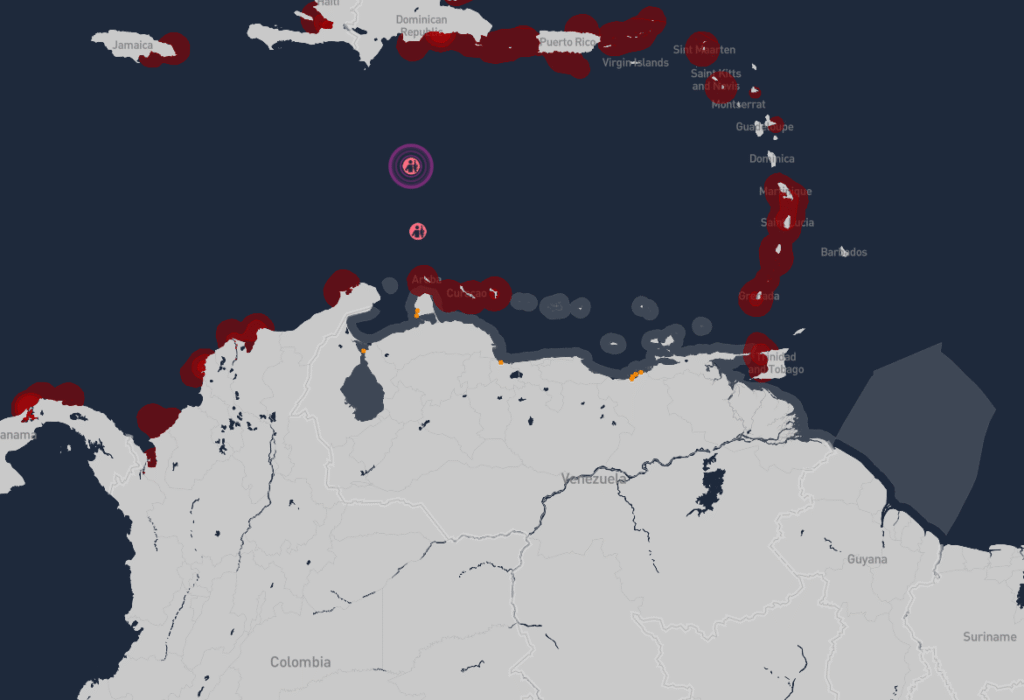
The United States conducted a missile strike from an Unmanned Aerial Vehicle (UAV) on a small boat operated by narco-traffickers in the Caribbean Sea. The vessel had reportedly departed Venezuela and was “positively” identified as belonging to the Tren de Aragua organised crime group, which the U.S. has designated as a terrorist organisation. Video footage released by the U.S. President, taken from the UAV, showed the small craft fitted with four outboard motors and carrying large bales assessed as narcotics. The footage captured the missile impact, followed by flames and smoke rising from the stricken vessel. At the time of writing, 11 casualties had been reported.
This marked the first known U.S. missile strike against Tren de Aragua and represents a notable escalation in Washington’s counter-narcotics modus operandi. The strike occurred against the backdrop of an increased U.S. naval presence in the Caribbean, signalling a more assertive approach to regional narcotics interdiction and organised crime networks linked to Venezuela.
Political and Strategic Context
The Chavista regime and Hugo Chávez’s successor, President Nicolás Maduro, have maintained a long-standing enmity toward the United States and its alleged “imperialist policies.” Rooted in Bolivarian socialism, Caracas has consistently positioned itself in ideological opposition and geopolitical rivalry with Washington, using anti-U.S. rhetoric to rally nationalist sentiment during elections and to discredit domestic opposition as “collaborators with imperialists.” In response, the U.S. has imposed extensive sanctions, diplomatically isolated Venezuela, and openly supported opposition parties during elections. Maduro, in turn, has sought to cast Venezuela as a key node of resistance to U.S. influence in Latin America, strengthening military and economic partnerships with Russia, China, and Iran.
In 2022–2023, relations between the two countries saw a brief, pragmatic thaw under President Biden. Washington granted Chevron a limited licence in November 2022 to resume pumping and exporting Venezuelan oil under strict conditions. This represented the first diplomatic opening since 2019, when the U.S. recognised Juan Guaidó as interim president and imposed sweeping sanctions. The Biden administration’s approach was transactional, aimed at offsetting global oil supply disruptions caused by Russia’s invasion of Ukraine, while Maduro sought sanctions relief and international legitimacy.
This shift has since reversed. Under President Trump’s second term, U.S. policy has hardened considerably. The White House Press Secretary recently declared: “President Trump has been clear and consistent—he is ready to use any element of U.S. power to stop drugs flooding into our country. The Maduro regime is not the legitimate government of Venezuela; it is a narco-terror cartel.” Maduro is portrayed by Washington as a fugitive head of state indicted for trafficking narcotics into the U.S., with the Department of State doubling its reward offer from USD 25 million to 50 million for information leading to the arrest or conviction of the leader of the specially designated terrorist cartel De Los Soles.
Analysis of Maritime Security Risks
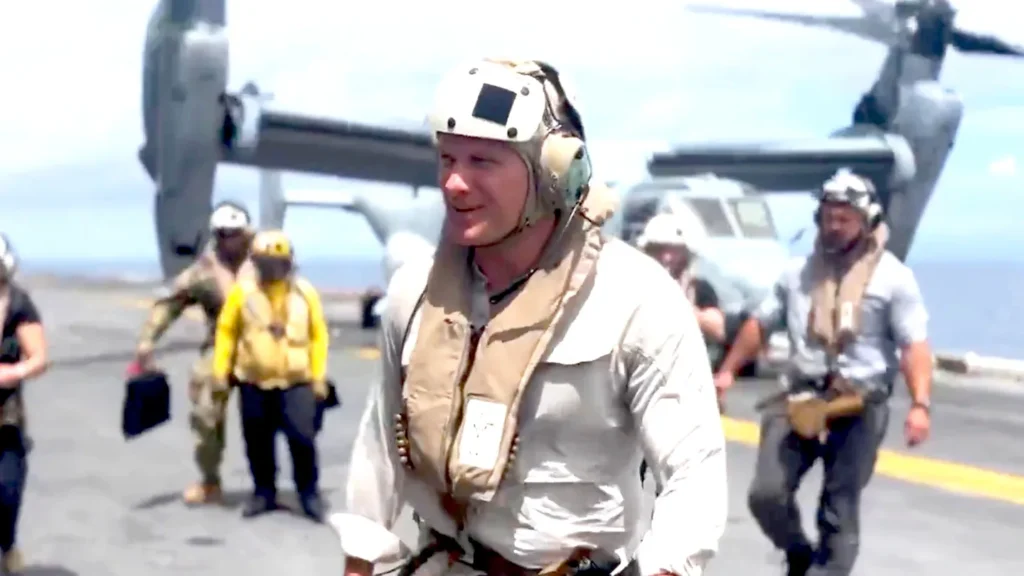
The United States has significantly bolstered its naval presence in the Caribbean, deploying warships and support assets close to Venezuelan waters. This show of force was coupled with a large-scale amphibious landing exercise in Puerto Rico, underscoring Washington’s readiness to project power in the region. The exercise was visited by U.S. Secretary of War Pete Hegseth, whose visit highlighted the strategic importance the Trump administration places on its new, more assertive approach to regional security and deterrence. While Washington frames the deployment as part of counter-narcotics operations, the manoeuvre also serves as a deterrent signal to Caracas amid disputes over Guyana’s Essequibo region, continued sanctions enforcement, and Venezuela’s deepening ties with Russia, Iran and China.
Ambrey assesses it as unlikely that the U.S. intends to launch a large-scale regime-change operation. However, it is a realistic possibility that President Trump’s administration will use its naval presence to impose a form of economic coercion. Naval assets will likely be leveraged in three key ways: first, by restricting the flow of illicit goods in and out of Venezuela, cutting into the revenue streams of regime-linked elites who profit from trafficking networks; once the small boats transits are suppressed, it is likely that the traffickers will increase the targeting of merchant vessels to transport the illicit goods. There is a realistic possibility that this will give impetus for vessel inspections, granting Washington greater visibility into how sanctions on Venezuelan oil exports are being breached. China continues to purchase a significant share of Venezuelan seaborne crude, but rather than seeking to eradicate these flows, the U.S. is likely to pursue a strategy of calibrated sanctions designed to constrain them. This approach enables Washington to keep the Maduro regime weak and dependent, while simultaneously limiting Sino-Russian influence in Venezuela. At the same time, the U.S. can maintain leverage by selectively extending Chevron licences, balancing pressure with controlled engagement.
Implications for Maritime Operations
The risk of miscalculation remains high. Venezuelan naval aviators have recently conducted proximity overflights of U.S. warships, a “provocative manoeuvre” that could escalate quickly. Asked about the incident, President Trump addressed a general in the Oval Office, “If it happens again, you have a choice of doing anything you want. If they put us in a dangerous position, they will be shot down, ok?” Additionally, close encounters between U.S. naval vessels and Venezuelan patrol assets could spark an incident requiring both sides to respond in kind, heightening the risk of armed confrontation in contested waters.
For commercial shipping, the implications could become considerable. Merchant vessels calling at Venezuelan ports may face delays or restrictions as naval forces intensify monitoring of port approaches and anchorages. U.S. surveillance of sanctioned oil exports is likely to expand, exposing tankers and support craft involved in Venezuela’s energy trade to interdictions, seizures, or denial of services at foreign ports. Should U.S. interdictions escalate to seizures, insurance premiums for War and War Loss of Hire for vessels operating in Venezuelan waters and transiting the southern Caribbean would likely rise, while compliance checks would become more intrusive. Offshore oil and gas projects are also vulnerable, with U.S. forces able to disrupt supply chains and restrict access to critical support.
Escalating tensions could drive Venezuela to retaliate by deepening ties with Russia and China, potentially leading to a long-term militarised presence in the Caribbean and raising regional security risks. If the U.S. naval presence begins to meaningfully impede Venezuela’s oil exports, it is a realistic possibility that Caracas will employ electronic warfare (EW) measures to obscure merchant vessel operations, mirroring tactics already used by Russia in the Baltic Sea and Iran in the Persian Gulf. Such measures would likely cause widespread collateral impacts. These disruptions complicate compliance with port authorities, heighten the risk of navigational accidents, and increase operational uncertainty for commercial shipping.
Mitigation Measures and Affiliation Assessments
Over the past two years, Ambrey has developed a comprehensive affiliation assessment framework designed for the shipping and insurance industries. The purpose of this assessment is to determine whether vessels, fleets, or associated entities have affiliations that could create security concerns or risk denial of service.
Our analysts identify and evaluate perceived links between vessels and their owners, operators, corporate structures, trading patterns, and country connections. This process draws on multiple maritime databases, stock market intelligence, research on individuals and family ownership structures, specialist trade analysis, and open-source reporting. Each assessment produces a clear, graded profile of affiliation strength, tailored to the relevant risk environment.
CONTACT INFORMATION
Ambrey: +44 203 503 0320, intelligence@ambrey.com
AMBREY – For Every Seafarer, Every Vessel, Everywhere.