AMBREY THREAT CIRCULAR> MARITIME SECURITY IMPLICATIONS OF THE US OPERATION IN VENEZUELA
Date released: 07 January 2026
“Ambrey advises shipping companies to conduct Voyage risk assessments to support operational planning in high war-risk regions, supporting proactive threat mitigation and the identification of alternative routing strategies as security conditions continue to evolve.”

Source: This document has been approved for distribution by Ambrey Analytics Ltd.
EXECUTIVE SUMMARY
- As in the 2025 US strikes on Iran, the US operation on 3 January 2026 demonstrated that regional adversaries possess significant vulnerabilities and do not benefit from credible collective deterrence.
- There was widespread disruption to airline operations across the Caribbean Sea, with numerous flight cancellations, creating potential knock-on impacts for the cruise industry, crew transfers, and contingency evacuation planning.
- In the near term, the blockade is likely to continue and remain contested, sustaining uncertainty for sanctioned shipping and enforcement dynamics.
- While Venezuelan incumbents are likely to accept cooperation, there remains a realistic risk of episodic follow-up action and broader US coercive signalling.
- Adversary efforts to re-establish deterrence increase the likelihood of miscalculation or asymmetric escalation, particularly if there were to be a degradation in US-European alliance cohesion.
- Sustained US pressure is likely to displace narcotrafficking routes toward the Pacific or towards concealment on merchant shipping.

SITUATION
On 3 January 2026, the United States conducted a military operation in Venezuela, announcing the capture of President Maduro and his wife Cilia Flores. The US has not publicly disclosed which bases were used during the operation; aside from confirmation that the amphibious assault ship USS IWO JIMA was involved post-capture. There has not been any direct regional spillover.
The impact on merchant shipping was negligible during the operation. A port facility was damaged the same night at La Guaira. No merchant vessels were present at the time. At the time of writing, the cause or circumstances of the damage had not been explained. It is not anticipated to impact planned port calls.
Though the government declared a state of emergency, port operations were said to be continuing without significant delays. At the time of writing, Ambrey had confirmed with port agents that the ports of Puerto Cabello, Maracaibo, Guaranao and Guanta were operating normally.
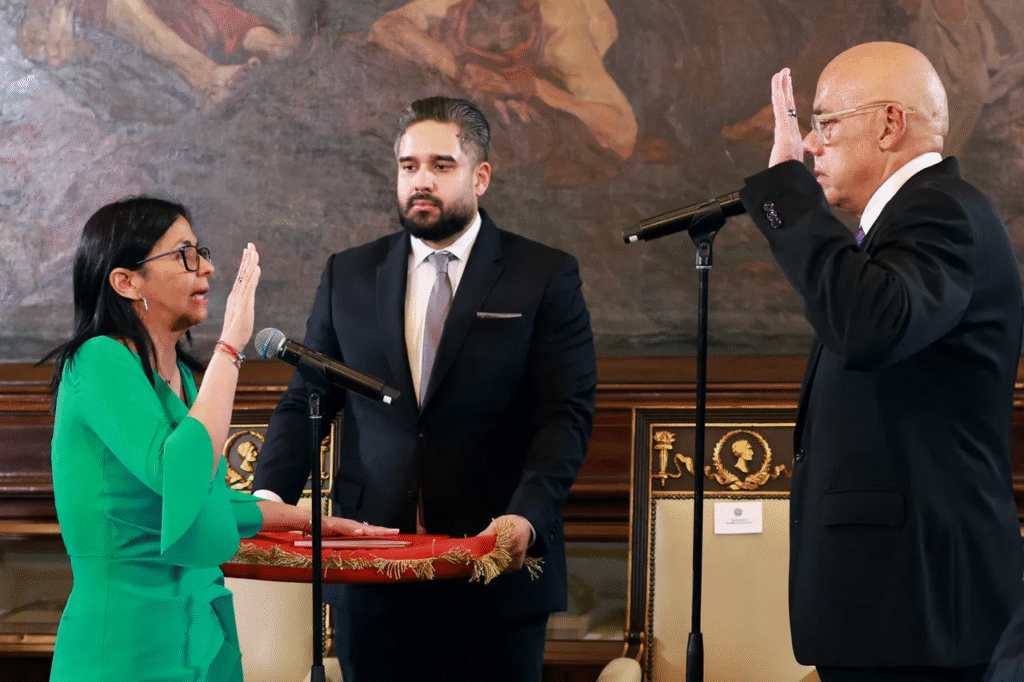
Airline operators did suspend several hundred flights in the Caribbean Sea. The extent of the disruption was wide-ranging, even to islands unconnected to recent US operations and military infrastructure. Ambrey was made aware of changes in cruise ship itineraries as an indirect consequence of the operation. Regional airspace disruption may have affected planned crew transfers and contingency movements. There does appear to be continuity in leadership of Venezuela; the US President dismissed opposition figure María Corina Machado as lacking sufficient support to take control, indicating no immediate expectation of a transition; and Venezuelan Vice-President Rodríguez assumed the acting presidency. President Trump warned that she would “pay a very big price, probably bigger than Maduro” if she failed to comply with US demands. On 4 January, she issued a statement that she had “invited the US government to work together on an agenda of cooperation”.
CONTEXT
The capture of President Maduro was not unexpected, having been foreshadowed by a series of escalatory measures. The speed and ease with which he was captured, however, was surprising. US officials have stated that no US personnel or equipment were lost during the operation. Despite Venezuela fielding a layered, Russian-supplied air-defence architecture, the country was unable to mount an effective response. Russia, China and Iran have criticised the US operation but have so far avoided material escalation, suggesting limited willingness or ability to contest US action in Venezuela beyond diplomatic signalling. This has implications for Venezuela and other US adversary deterrence credibility and escalation dynamics. Comparable US actions elsewhere, including against Iran, have historically prompted efforts to reconstitute deterrence capabilities rather than de-escalation.
It is assessed likely that the Venezuelan incumbents will make concessions. President Trump announced on 6 January that Venezuela would “turn over between 30 and 50 million barrels of oil” to the US. It was not published over what period, nor confirmed if it was new. Chevron are estimated to produce more and ship more to the US per annum. Recognition within Venezuela of its vulnerability to US action suggests a reduced willingness to actively secure crude oil and oil product shipments or challenge the blockade. There are, however, plausible scenarios in which the US undertakes follow-up military action. The presence of several other US-indicted individuals and vested interests could incentivise delays or stall Venezuelan engagement.
There appear to have been challenges in implementing the blockade. Only two tankers have been seized by the US so far. Tanker industry analysts disclosed that four US-sanctioned tankers departed Venezuela the same day as the operation to capture Maduro. They were reportedly laden with crude oil and fuel oil. They withheld AIS transmissions as they did so. Another tanker that was reportedly about to be seized reflagged to the Russian registry and fled, with the US in pursuit.
The Venezuelan establishment remains largely intact, and military and militia are mobilised. There have not yet been popular protests for a change in government, though this is possible in time. Violence toward protestors could constitute a reason for further intervention. The relative stability indicates the risk of disruption remains low at present. If there are perceived delays or stalling of talks with the US, this could also trigger similar US intervention.
Since the operation, President Trump has issued coercive statements extending beyond Venezuela, signalling a broader willingness to apply pressure. This follows similar threats and military action directed toward Iran in 2025 and has since included warnings toward Colombia and Mexico over narcotics flows, remarks on Cuban regime fragility, and renewed assertions that US control of Greenland is “necessary for national security”. Collectively, these remarks are assessed as deliberate coercive signalling designed to extract compliance and reinforce perceptions of US freedom of action.
IMPLICATIONS FOR SHIPPING
Chevron already operates in Venezuela under license and has continued its chartering operations since the capture of Maduro. Even amid the increased pressure prior to his capture, Maduro was explicit that his administration would respect its contractual relationship with Chevron. President Trump has stated his expectations that the US oil industry would be ‘up and running’ within 18 months in Venezuela.
According to commodity analysts, market dynamics suggest that Iran, Russia, Colombia, and Canada could emerge as indirect beneficiaries of the continued US oil blockade on Venezuela, driven by Chinese demand for heavy crude. This could be complicated for Iran and Russia if the US were to seize sanctioned tankers that operate in the respective ‘dark fleets’ as it could reduce available tonnage.
Despite the state of emergency, there have been no reports of this having caused significant disruption to shipping.
Uncertainty over the US intentions towards other countries is highly unlikely to deter merchant traffic from calling them. The US operation was restrained in scope. Outside La Guaira, there were no reports of any damage to port facilities, even in ports in which civilian and naval facilities were co-located. This indicates the surgical nature of the operation, but also the American interest in the national infrastructure.
A longer-term risk is destabilisation driven by adversary attempts to re-establish deterrence and uncertainty regarding the rules-based international order and alliance networks, increasing the potential for miscalculation.
Narcotrafficking dynamics are likely to change. Sustained US operations and continued strikes would likely shift small boat trafficking routes away from the Caribbean towards the Pacific, increasing enforcement activity and maritime security operations across a broader area. Vessels transiting the eastern Pacific may face an increased exposure to small boat activity and narcotrafficking threat actors. Concealment amongst cargo or attached to merchant ship hulls could be a lower-risk alternative modus operandi in the Caribbean Sea.
RECOMMENDATIONS
- It is advised to engage with intelligence providers to closely monitor US intentions, and to assess the possible reactions of adversaries against target profiles.
- Shipping companies are welcome to have a conversation with Ambrey to talk through scenarios.
- Voyage risk assessments: It would be advised to conduct these assessments in locations where there is increased war risk, and to consider possible alternate/lower risk voyage plans considering the dynamic threats.
- Shipping calling Venezuela is advised that, since a national emergency has been declared, they should reassess port operational status regularly, and whether to call ports co-located with military facilities.
- Crew transfers plans and evacuation contingency plans could use these airline reactions to test scenarios.
- In case of a response by Venezuelan military, and to de-conflict with US assets, shipping underway through the Caribbean Sea is advised to maintain a sea room policy from any naval assets and to report their presence to Ambrey for others to be dynamically re-routed.
CONTACT INFORMATION
Ambrey: +44 203 503 0320, intelligence@ambrey.com
AMBREY – For Every Seafarer, Every Vessel, Everywhere.
END OF DOCUMENT