US Military Build-Up Offshore Venezuela & Merchant Shipping Risks
Date issued: 06 November 2025
US military build-up offshore Venezuela is increasing maritime security risks across the Caribbean Sea, creating a more complex operating environment for merchant shipping transiting near Venezuelan waters. Expanded US naval deployments, continued counter-narcotics strikes, and heightened geopolitical tensions between Washington and the Maduro government are contributing to elevated regional security concerns and potential secondary risks for commercial vessels.
Source: This document has been approved for distribution by Ambrey Analytics Ltd.
EXECUTIVE SUMMARY
- Since US military forces were deployed in the Caribbean Sea in August 2025, 14 strikes have occurred, resulting in more than 50 reported fatalities.
- The US government has classified the campaign as a “non-international armed conflict” targeting narco-terrorist organizations. However, Washington has maintained a firmly adversarial stance toward the government of Nicolás Maduro when announcing the attacks.
- In this scenario, the strikes are likely a strategic demonstration of force, reflecting US opposition to Maduro’s policies.
- There is a realistic possibility of more strikes offshore Venezuela, potentially extending inland. However, Ambrey assesses a low likelihood of a broader US military conflict with Venezuela in the short-term.
- Ambrey assesses a realistic possibility that cartels will start exploiting merchant vessels as a lower-exposure trafficking method.
- Precautionary planning and strengthened counter-narcotics measures are recommended to mitigate potential secondary impacts.
US Military Activity Offshore Venezuela
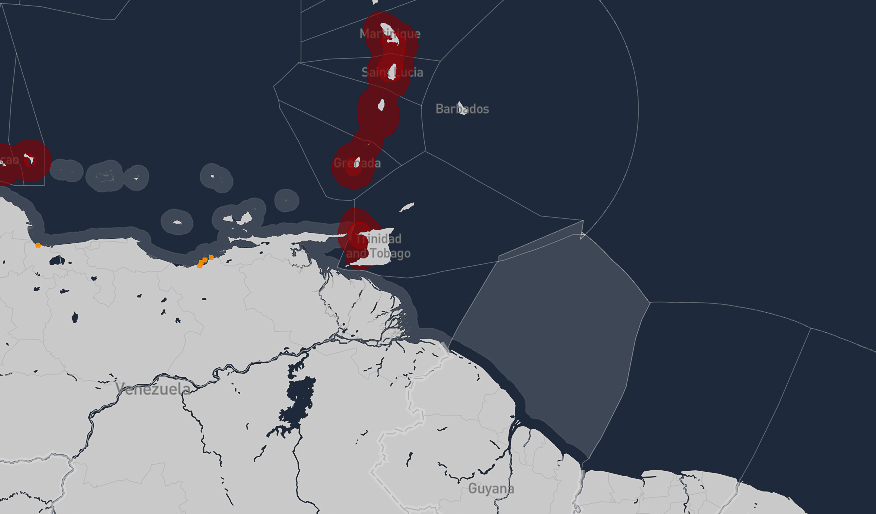
Starting in August 2025, the Trump administration ordered the deployment of several US naval vessels and other forces to the southern Caribbean as a counter narcotics measure against “narco-terrorist” organizations. The first action performed by the units took place a month later on 2 September 2025 where US conducted a missile strike from an Unmanned Aerial Vehicle (UAV) on a small boat operated by narco-traffickers in the Caribbean Sea. Since then, the US has maintained a large amount of military assets including troops that amount more than 4500 marines and sailors, guided-missile destroyers, a guided missile cruiser, a special operations ship and the Iwo Jima Amphibious Ready Group.
Escalating Tensions Between the US and Venezuela
The deployment of the military assets and the attacks had marked a significant escalation in tensions between the US and the government of Venezuelan President Nicolás Maduro. At the same time, the government of Donald Trump has been clear about its stance against the Maduro government, imposing extensive sanctions, diplomatically isolating Venezuela and supporting opposition parties during the election. In the country’s fight against the narcotrafficking in the Caribbean Sea, the US government has addressed Nicolás Maduro as “the leader of the specially designated global terrorist Cartel de los Soles”, offering a reward up to US $50 million for information leading to the arrest of the Venezuelan president.
Expansion of US Military Operations and Regional Presence
Most recently, the US has taken broader political and strategic steps, including authorizing the CIA to conduct covert operations in Venezuela, further reinforcing its pressure on the Maduro government and expanding its actions in the fight against narcotrafficking. Since then, US forces have carried out 14 strikes within the SOUTHCOM area of operations, including eight in the Caribbean Sea and six in the Eastern Pacific, resulting in over 50 reported fatalities. US officials emphasized that the operations occurred in international waters, but this can include exclusive economic zones.
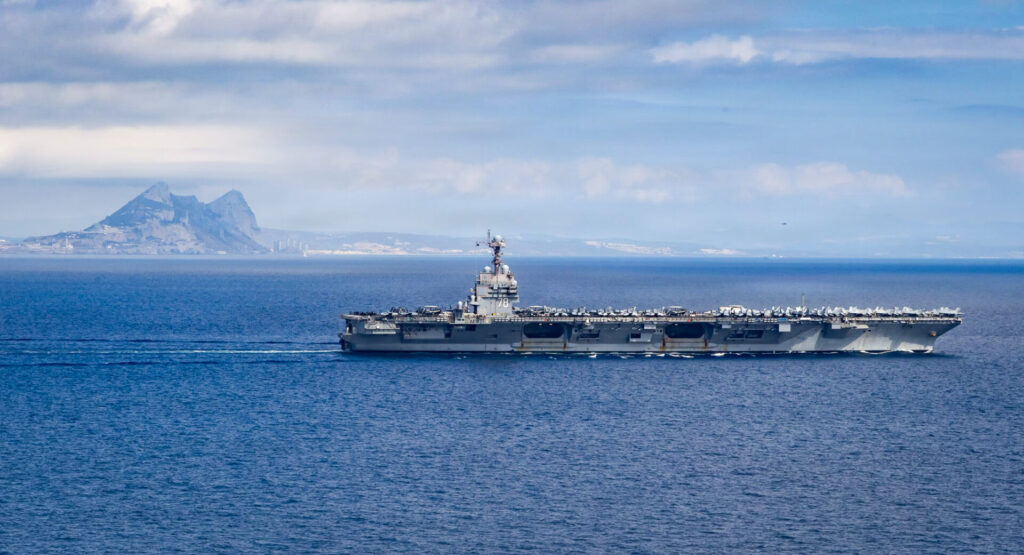
The US has strengthened its regional military posture. Satellite imagery indicates that the US has reopened a naval base in Puerto Rico after more than two decades of inactivity and deployed F-35 fighter jets to the island, to support US operations in the Caribbean. Most recently, the announcement of deployment of the USS GERALD FORD in the Caribbean, along with a guided-missile destroyer operating near Trinidad and Tobago, demonstrates a significant increase in the US presence and capability in the area.
Analysis
US Strategic Pressure on Venezuela
The US military activity indicates a broader strategy of pressure towards the Venezuelan government. Although the US has justified the actions as part of a counter-narcotics campaign, the proximity of the attacks to Venezuelan waters and the political stance suggest that the operations go beyond this scope. The level of force deployed exceeds what would be expected for counter-narcotics operations, indicating preparedness to conduct sustained operations if required. The use of the counter-narcotics narrative appears to serve as a mean to sustain a strong US military presence, aimed at gathering intelligence, reinforcing deterrence and maintaining pressure.
Geopolitical and Economic Risks in the Region
Venezuela is not considered a primary narcotics transit route, however, while the value of narcotics to the regime remains unclear, it is likely substantial. Meanwhile, the US has considerable investments in neighbouring Guyana, whose territory remains disputed by Venezuela. At the same time, Venezuela presents both immediate risks and longer-term opportunities for US interests. Recently, Chevron has resumed oil exports in Venezuela under a special license, with cargoes arriving at US ports. Given the region’s oil potential, the US firms could benefit substantially in the event of regime change and the internationally recognized opposition assuming power. At a recent Council of the Americas event, opposition leader María Corina Machado presented a plan for Venezuela’s economic transformation, centred on market liberalization, privatization, and regulatory stability, measures that could favour US investment in the country. However, regime change is not a stated policy. Beyond the economic and political dimensions, broader security and migration challenges persist. Maduro maintains close ties with adversaries such as Cuba, Iran, and Russia. Earlier this year, under threat of sanctions, Venezuela accepted the return of hundreds of irregular migrants from the U.S., while related ICE operations continue.
Potential Threats to Merchant Shipping
In addition, as a direct consequence to the recent attacks the dynamics in the region may shift. Go-Fast boats remain the most common modus operandi employed by drug trafficking organizations, followed by the concealment of narcotics within legitimate cargo and the tampering of containers. As enforcement efforts continue to target Go-Fast operations, cartels may increasingly shift toward methods that reduce exposure of their shipments, including the use of merchant vessels as alternative means of transportation.
Recommendations for Merchant Shipping
Merchant shipping is advised to:
- Engage an industry-recognised intelligence specialist to regularly assess political and security risks to create a comprehensive, dynamic, risk profile for calls to Venezuela and transits near the Venezuelan coast.
- Enhance counternarcotics ship protection measures when calling Venezuelan ports.
- Conduct port risk assessments, and to prepare contingency plans if calling Venezuelan ports with integrated/adjacent naval bases.
CONTACT INFORMATION
Ambrey: +44 203 503 0320, intelligence@ambrey.com
AMBREY – For Every Seafarer, Every Vessel, Everywhere.