AMBREY INSIGHT> Sub-Saharan Africa: Maritime & Land-Based Threat Landscape
Date issued: 06 May 2026
“Sub-Saharan Africa’s natural resources sector experiences regionally differentiated security risks, requiring more adaptive and integrated protection strategies. While not uniform across the continent, indicators-particularly piracy in the Gulf of Guinea and ongoing instability affecting inland mining corridors-suggest a sustained near-term exposure to both maritime and land-based threats that could impact operational continuity. ”
EXECUTIVE SUMMARY
- Sub-Saharan Africa’s oil, gas, and mining sectors are vital to exports but face region-specific security risks.
- Offshore West Africa: Elevated piracy risk in the Gulf of Guinea continues to impact vessel operations, logistics, and crew movements.
- Offshore Angola, Congo and Namibia: Piracy threat is low, adherence to standard maritime security protocols is advised.
- Mining in East and Central Africa: The risk profile shifts to land-based threats, including armed robbery, militancy, civil unrest, and activism in ports.
- Each region requires tailored mitigation strategies aligned to its specific risk environment.
CONTEXT
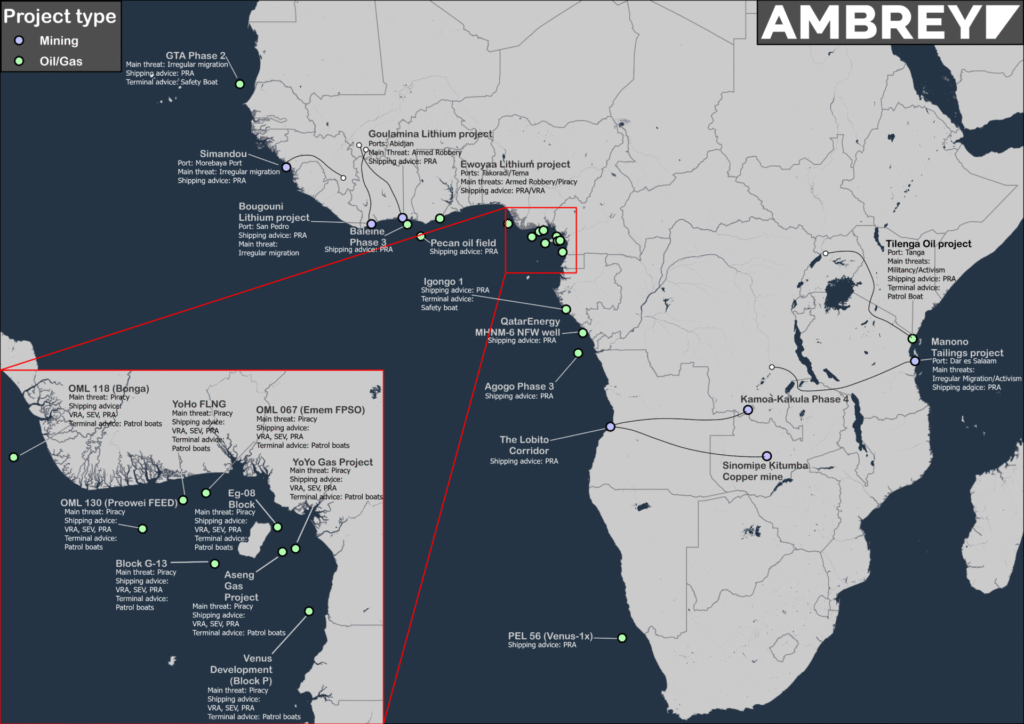
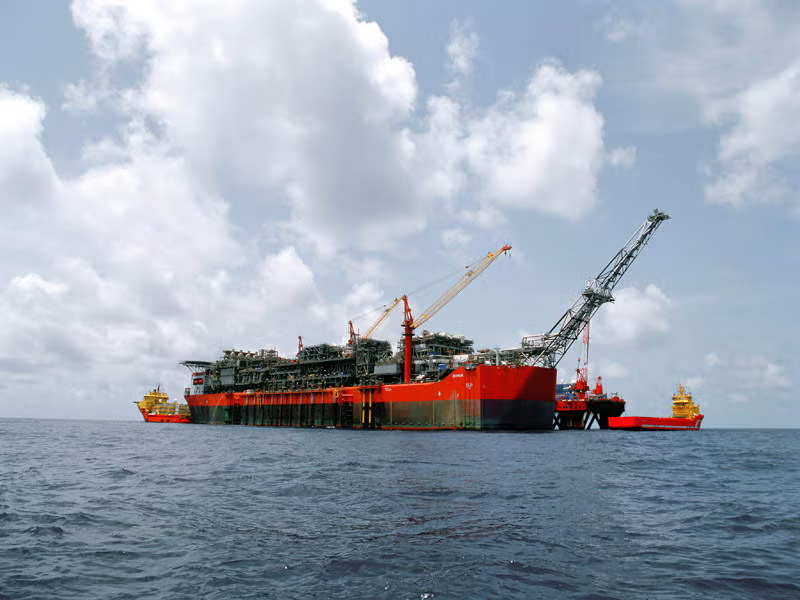
Sub-Saharan Africa’s oil, gas, and mining sectors remain central to the continent’s export economy, but the risks facing these projects vary widely by region. Across West Africa, a dense cluster of new upcoming offshore oil and gas projects stretch from Côte d’Ivoire through Ghana, Nigeria, Cameroon, Gabon and Equatorial Guinea. Many of these installations; such as FPSOs, FLNG platforms, and multi‑phase field developments, sit in high‑risk waters. The Gulf of Guinea in particular shows a notable concentration of projects where piracy remains the dominant maritime threat. Locations like OML 130, Yoho FLNG, Egina, and the YoYo Gas Project fall within an area where vessel operators must routinely factor in piracy risk during transit, supply runs, and crew changes.
Ambrey’s guidance for these offshore sites typically includes:
- Deployment of a Security Escort Vessel (SEV) to deter or respond to hostile approaches.
- Conducting a Vessel Risk Assessment (VRA) before entering or operating within the piracy‑prone zones.
- Use of patrol boats or enhanced terminal security for projects
Farther south, projects off Angola and Namibia face lower p|iracy pressure but still operate in regions where security precautions, such as PRA adherence and controlled approaches to offshore terminals, are considered best practice.
The map also displays significant mining projects inland and along the eastern coast, including lithium, copper, and tailings operations in Madagascar, Tanzania, the DRC, and Zambia. Here, the primary threats shift away from maritime piracy toward issues like armed robbery, militant activity, irregular migration, and activism. These sites lean more heavily on port‑related security measures, controlled transport corridors, and local threat monitoring rather than offshore escorts.
Taken together, the image illustrates how Africa’s extractive industries operate across a patchwork of risk environments. For offshore operators in the Gulf of Guinea, maritime security remains paramount, while inland and East African mining operators face more land‑based threats requiring tailored mitigation strategies.
CONTACT INFORMATION
Ambrey: +44 203 503 0320, intelligence@ambrey.com
AMBREY – For Every Seafarer, Every Vessel, Everywhere.
END OF DOCUMENT