AMBREY INSIGHT> THREAT TO PORTS RECEIVING RUSSIAN CRUDE OIL – LIMPET MINE ATTACKS
Date issued: 21 January 2026
“Ambrey advises that the most likely effects are short-notice disruption: temporary danger areas, denser military/law-enforcement traffic, and schedule volatility. Live-firing and parallel enforcement activities increase the risk of miscalculation. Maintain routing flexibility.”
Source: This document has been approved for distribution by Ambrey Analytics Ltd.
EXECUTIVE SUMMARY
- Limpet mine attacks against tankers carrying Russian-origin oil will likely continue in early 2026
- Each targeted tanker was laden at the time of the explosion.
- Ports receiving Russian crude or refined products may be indirectly exposed to this threat
- Vessels may be targeted after arrival, rather than during transit, particularly while alongside or at anchor
- The targeting may be designed to cause disruption to the port operations and to send a symbolic message to the oil recipient port
- The Russia-Ukraine peace talks continue, yet deep divergences persist between Ukraine’s insistence on territorial integrity and concrete security guarantees by the US, directly in contrast to Russia’s maximalist demands
SITUATION
There is assessed to be a heighted risk of further limpet mine attacks on merchant tankers carrying Russian oil and oil products.
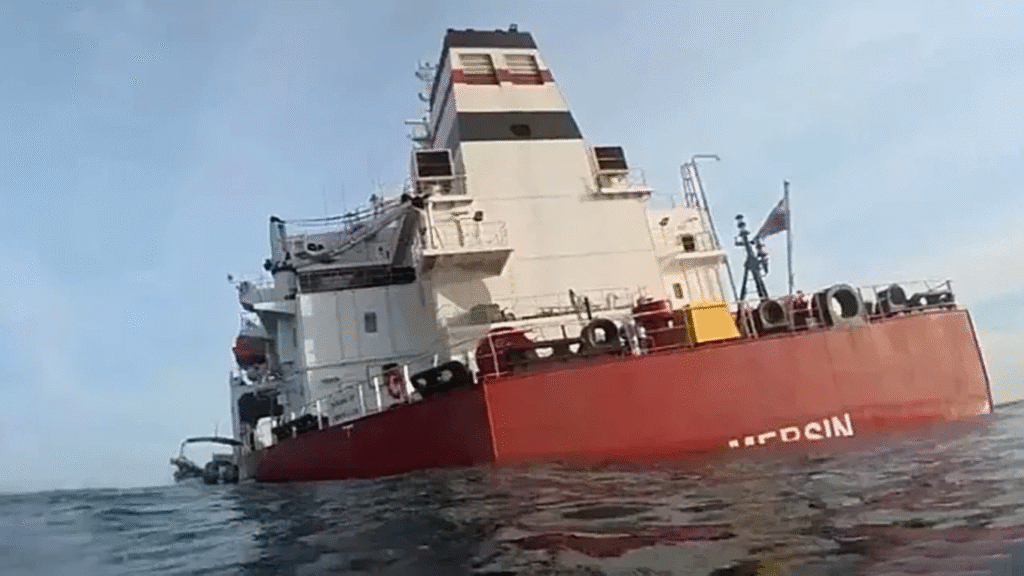
Since 2025, at least seven merchant vessels carrying Russian-origin oil have been targeted using limpet mines.
Target table:
| NAME | FLAG | OWNER NATIONALITY | VESSEL TYPE | CARGO CAPACITY | CARGO AT THE TIME OF EXPLOSION | RUSSIAN PORT CALL |
|---|---|---|---|---|---|---|
| MERSIN | Panama | Turkey | Oil/chemical products tanker (MR) | 50,138 DWT | 267,684 bbl -Diesel | Novorossiysk |
| ECO WIZARD | Marshall Islands | Greece | LPG tanker | 40,000 cbm | Ammonia during loading operations – Undisclosed | Ust Luga |
| VILAMOURA | Marshall Islands | China | Crude oil tanker (Suezmax) | 158,622 DWT | 762,158bbl | Novorossiysk |
| SEAJEWEL | Malta | Greece | Crude oil tanker (Aframax) | 108,888 DWT | 307,487bbl | Novorossiysk |
| KOALA | Antigua & Barbuda | Unknown Owners | Crude oil tanker (Suezmax) | 164,533 DWT | Fuel oil – approximately 130,000 tonnes | Ust Luga |
| GRACE FERRUM | Liberia | Unknown Owners | Products tanker (MR) | 50,000 DWT | Undisclosed | Ust Luga – St Peterburg |
| SEACHARM | Marshall Islands | Greece | Crude oil tanker (Aframax) | 112,200 DWT | 640,639bbl | Novorossiysk |
CONTEXT
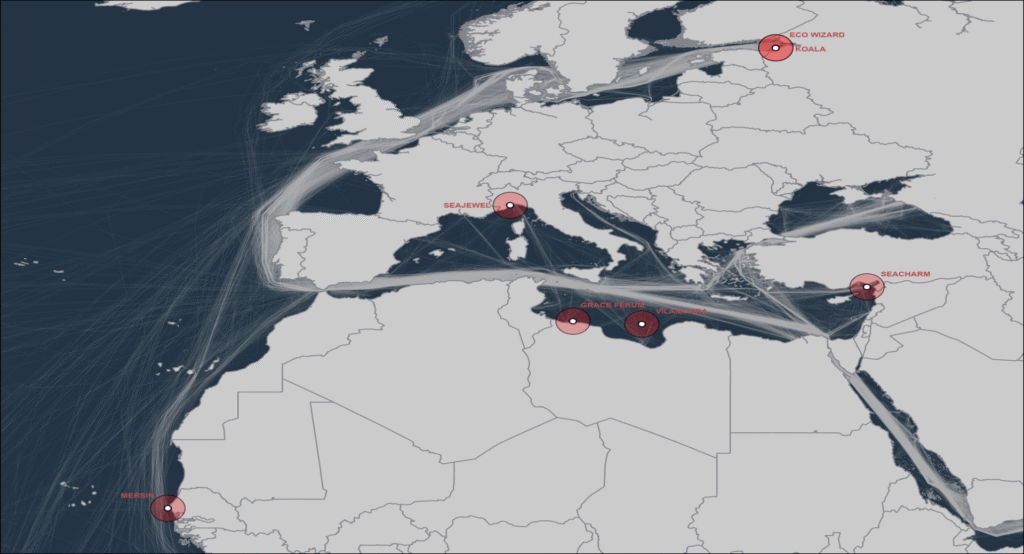
The mines can be time-delayed or remotely triggered, meaning the vessels can be at their next ports of call before the explosions occur.
Map showing locations of the explosions:
Impact table:
| INCIDENT DATE | NAME | DAYS BETWEEN DEPARTING RUSSIA & THE EXPLOSION | LOCATION OF THE EXPLOSION | NUMBER OF MINES | TIME TO RESUME TRADING |
|---|---|---|---|---|---|
| 27/11/2025 | MERSIN | 98 | At anchor/near the port of Dakar | 4 | Not trading ~1 month |
| 06/07/2025 | ECO WIZARD | N/A | Alongside/at berth, Ust-Luga, Russia | 3 | Not trading ~190 days |
| 26/06/2025 | VILAMOURA | 32 | Mediterranean Sea, 80Nm off Zueitina, Libya | 1 | ~6 months |
| 14/02/2025 | SEAJEWEL | 29 | At anchor/anchorage Savona-Vado, Italy | 2 | ~2 months |
| 09/02/2025 | KOALA | N/A | Alongside/at berth, Ust-Luga, Russia | 3 | Likely total loss. AIS transmissions have been lost since the incident |
| 01/02/2025 | GRACE FERRUM | 33 | Off Libya (reported near Tobruk) | 2 | 6+ months |
| 17/01/2025 | SEACHARM | 46 | Near the port of Ceyhan, Turkey | 2 | ~3 weeks |
Observed Impact on Vessels and Ports
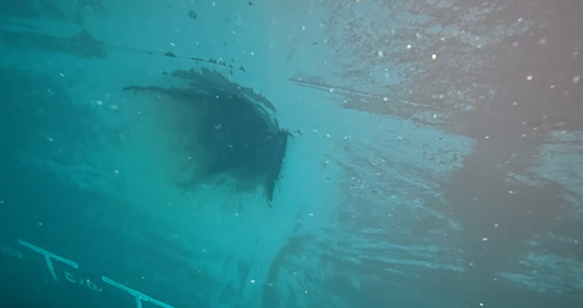
Analysis of confirmed and suspected limpet mine incidents indicates a consistent and deliberate attack methodology, resulting in vessel disablement and prolonged port disruption.
In all assessed cases, physical damage to the hull was observed, with hull plating deformed inwards, consistent with the detonation of externally attached explosive devices. The placement of the limpet mines was primarily at the aft section of the vessel, a critical vulnerability point.
This placement resulted in:
- Damage to steering gear and rudder assemblies
- Breaches to the engine room space, leading to flooding
- Complete loss of propulsion and manoeuvrability
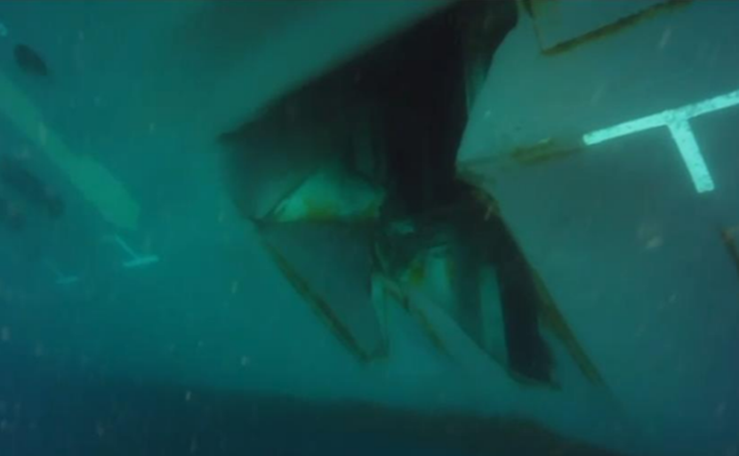
In the majority of the incidents, the vessel was rendered non-operational and unable to proceed under its own power, necessitating emergency response, salvage support, and extended repair periods.
In cases where explosions occurred while the vessel was alongside or conducting port operations, notably ECO WIZARD and KOALA, the impact on port operations was severe and prolonged. These vessels were unable to vacate the berth or port limits for extended periods, remaining alongside for several months. ECO WIZARD alone remained immobilised for over 150 days, significantly constraining berth availability and port throughput.
Beyond the direct damage to vessels, affected ports were compelled to:
- Implement enhanced security and screening measures
- Conduct mandatory underwater hull inspections for inbound tankers
- Increase coordination with port state control, insurers, and flag states
- Manage prolonged operational and reputational disruption
These incidents demonstrate that limpet mine attacks were designed to cause partial loss to targeted vessels; however, in practice, they have imposed significant operational disruption, economic loss, and compliance risk on ports, extending well beyond the immediate damage to the vessel itself.
Ports receiving Russian crude or refined petroleum products are exposed to significant secondary risks following a limpet mine incident, extending past the immediate physical damage to the vessel. The recovery and remediation process places substantial operational, legal, and compliance burdens on port authorities, terminal operators, and service providers.
Following an explosion, ports are required to conduct enhanced due diligence and sanctions screening, even in cases where the cargo itself is not explicitly sanctioned.
This includes:
- Verification of cargo origin and ownership
- Screening of vessel ownership, management, and beneficial interests
- Assessment of charterers, traders, insurers, and financial counterparties
- Engagement with national authorities to confirm compliance with US, EU, and UK sanctions regimes
These checks are often time-critical yet complex, and delays in confirmation can significantly extend vessel immobilisation alongside or at anchor.
The availability of salvage and towage assets presents a further constraint. Limpet mine damage typically affects propulsion and steering systems, requiring:
- Explosive ordnance survey & clearance
- Specialist salvage contractors
- High-capacity tugs capable of operating in confined port waters
- Coordination with classification societies and flag states
In many regions, suitable salvage and towage resources are limited or not immediately available, resulting in extended berth occupation and disruption to port operations.
Where cargo discharge is required to facilitate repairs or refloating, ports may need to identify and approve ship-to-ship (STS) transfer operations, often under heightened scrutiny. This process can be delayed by:
- Limited availability of suitable receiving vessels
- Restrictions imposed by insurers or authorities
- Jurisdictional limitations on STS operations within territorial waters
- Permissive sea state
Jurisdictional complexity further compounds the challenge. Depending on the location of the incident, ports may be required to coordinate with:
- Port State Control authorities
- Flag state investigators
- Coastal state environmental agencies
- Law enforcement and security services
In parallel, ports must support or facilitate multiple technical and regulatory surveys, including:
- Class and condition surveys
- Forensic examinations of hull damage
- Environmental damage and pollution risk assessments
- Structural integrity and safety reviews prior to any movement of the vessel
Environmental exposure represents a critical concern. Even in the absence of a spill, ports may be required to implement precautionary pollution response measures, deploy containment assets, and conduct environmental impact assessments, all of which carry operational and financial implications.
Human factors also contribute to prolonged disruption. Crew members may need to be:
- Repatriated or rotated due to extended immobilisation
- Interviewed as part of investigations
- Temporarily housed ashore under port authority oversight
Collectively, these factors result in extended vessel downtime, berth unavailability, and sustained operational strain on ports. The cumulative effect demonstrates that ports receiving Russian crude or products face material exposure to recovery, compliance, and reputational risks, even where the cargo itself may ultimately be deemed lawful.
Ambrey is aware that, in at least one incident within the series of limpet mine attacks against tankers, one of the explosive devices detached from the vessel and sank to the seabed within the port. As a result, the affected port was required to deploy explosive ordnance disposal (EOD) divers to conduct subsea searches to determine whether any additional unexploded ordnance remained in the vicinity.
While this response primarily resulted in delays to salvage and recovery operations, it highlights a realistic worst-case risk scenario. Detached limpet mines may be moved by tidal currents or seabed disturbance, potentially drifting into the proximity of other vessels, port infrastructure, or berthing areas. In such circumstances, an unexploded device could pose a latent threat to non-targeted vessels operating nearby, with the potential to cause secondary damage or casualties.
This risk further compounds the operational burden on ports, as it may necessitate:
- Temporary suspension of vessel movements
- Extended exclusion zones
- Repeated EOD sweeps prior to resumption of normal operations
The presence or suspected presence of unexploded ordnance therefore, represents a significant escalation in port safety and operational risk, reinforcing the importance of proactive screening, early detection, and preventative mitigation measures to reduce the likelihood of limpet mine devices entering port environments.
RECOMMENDATIONS
Ambrey assesses it would be prudent and proportionate for ports to implement:
- Pre-arrival asset screening assessments for inbound tankers.
- Compulsory underwater hull inspections for vessels assessed as high risk.
- Enhanced scrutiny of vessels with:
- Recent Russian port calls
- Sanction-exposed ownership or management structures
- AIS irregularities or opaque trading patterns
Ambrey has developed a mature and evidence-based methodology derived from vessels that have already been targeted. This allows Ambrey to:
- Identify vessels most likely to be targeted by limpet mine attacks
- Provide actionable asset screening assessments to port authorities
- Support risk-based decision-making without disrupting legitimate trade
This capability enables ports to reduce the likelihood of a vessel being disabled alongside, protecting Port infrastructure, Personnel safety, and business continuity
CONTACT INFORMATION
Ambrey: +44 203 503 0320, intelligence@ambrey.com
AMBREY – For Every Seafarer, Every Vessel, Everywhere.
END OF DOCUMENT