AMBREY INSIGHT>TURKEY IMPOSES RESTRICTIONS ON ISRAEL-AFFILIATED VESSELS

Source: This document has been approved for distribution by Ambrey Analytics Ltd.
EVENTS
- Ambrey has recorded several instances in which Israeli-affiliated vessels or vessels carrying “banned cargo” destined for Israel have been denied entry to Turkish ports.
- On 22 August, Ambrey confirmed with a trusted port agent that Turkish Port Authorities had verbally communicated several restrictions; these were listed by the agents.
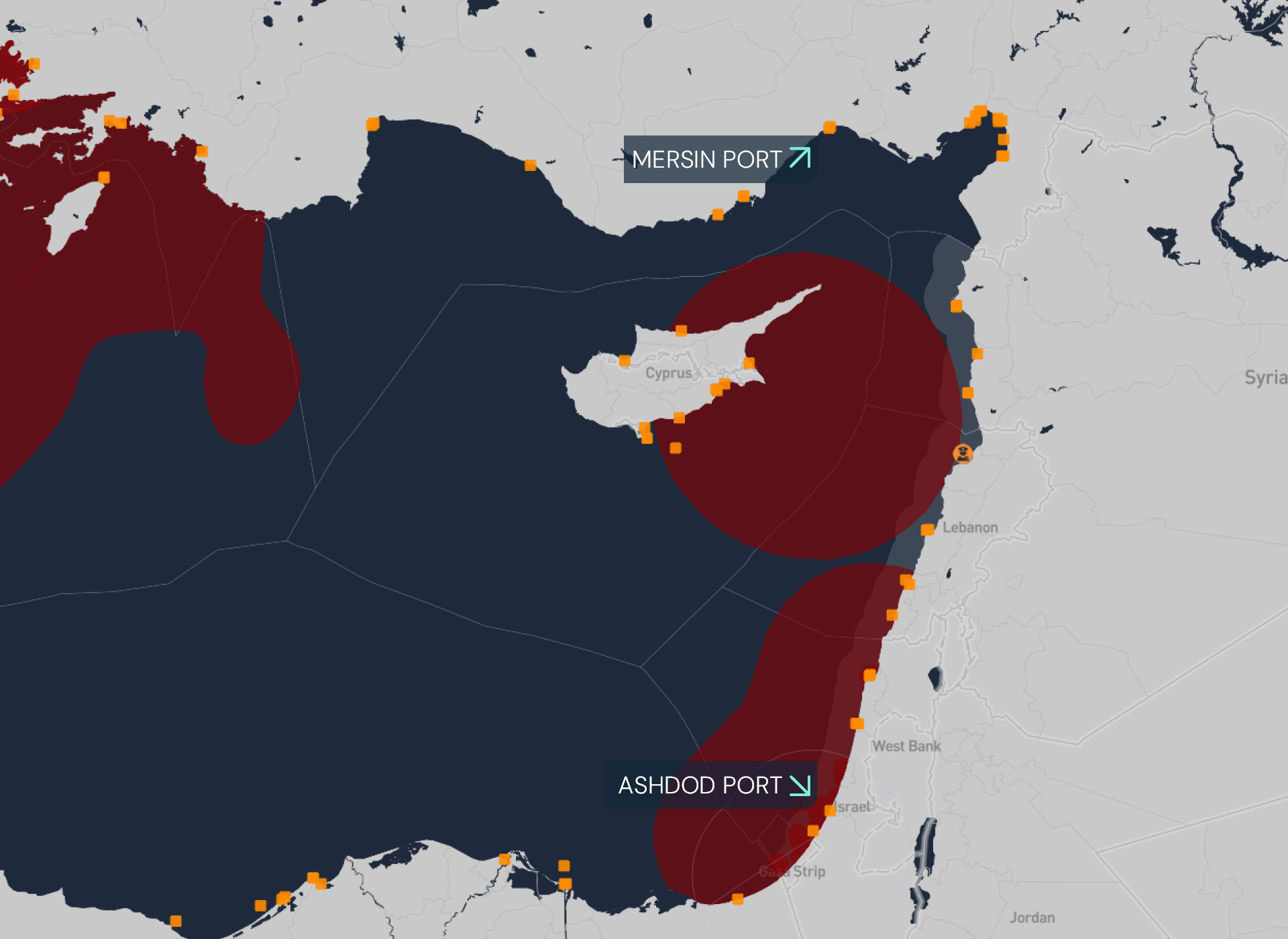
- On 25 August, still before the release of written Turkish guidance, a container ship was denied entry to Mersin. The vessel, enroute from Barcelona, Spain, was only 17NM from Mersin when she changed her destination to Ashdod. The vessel was owned by an Israeli company.
- The same day, the owner/operator stated that all vessels owned, managed, or operated by Israel would not be permitted entry to Turkish ports.
- Documentation has since been issued, and a further container ship vessel, regularly scheduled to call Israel and Turkey, was denied entry.
CONTEXT
Turkish authorities have explained their actions as a foreign policy decision. This declaration followed an extraordinary session of the Turkish Parliament convened to address the escalating conflict in Gaza, during which the Foreign Minister announced sweeping measures against Israel. The measures are part of a much broader detachment of political and economic ties. The Turkish Parliament formally ordered a “total severance of trade and political relations with Israel”. In the maritime domain, the embargo prohibits all Israeli-flagged vessels and those affiliated with Israel from accessing Turkish maritime facilities, including ports, shipyards, and support services. Additionally, vessels carrying specific categories of cargo bound for Israel are banned from transhipment or handling during port calls.
ANALYSIS
President Erdogan has been consistent in his condemnation of Israeli military operations in Gaza. As early as October 2023, President Erdogan criticised their actions and described Hamas as “liberators” and “mujahedeen”. In April 2024, Turkish authorities announced restrictions on exports to Israel, and in May 2024 a complete export ban. The President’s political party, the Justice and Development Party (AKP), has had relations with Hamas for many years. This has received political support from some ‘Islamist’ and ‘anti-imperialist’ groups within Turkey. His stance is different to that of the Republican People’s Party (CHP). The Mayor of Istanbul, Ekrem İmamoğlu, who won re-election in March 2024, has condemned the “oppression” of Palestinians, but has called Hamas “terrorists”. He was the sole Presidential candidate for the CHP and was arrested earlier in 2025. In summary therefore, there are assessed to be highly influential domestic considerations driving the Turkish Government’s policies. Loosening restrictions without a ceasefire in Gaza is highly unlikely. Israeli and Turkish foreign policy has complementary and conflicting strands. The sides have different policy objectives in Syria, but they are not mutually exclusive. Maritime boundary disputes in the Mediterranean Sea and alignment between Israel and Greek interests is a source of friction, but there are also opportunities for collaboration between Israel and Turkey in natural gas exports too. Turkey already facilitates the transportation of Azeri oil to Israel via Ceyhan.
IMPLICATIONS
At the time of writing, Israel had not responded in kind. In fact, as the container ship was being denied entry to Israel, a Turkish-flagged, Turkish-owned tanker called Israel with its AIS transmissions off. Israel is more likely to prioritise its economic relations, and to facilitate commercial pragmatism.
Several countries have introduced restrictions on cargo destined for Israel, and banned Israeli-flagged ships from docking at their ports.
Adding to this, some non-state actors have co-ordinated protests directed towards sensitive cargo shipments destined for Israel, and also protested the arrival of Israeli ships.
It is assessed to be a realistic possibility that restrictions will be applied by others. In practice, the extent to which these are defined, implemented, and adhered to will be complex. A clear understanding of vessel and business affiliations will be critical to mitigating commercial disruption and maximising commercial utility.
SOLUTION
The advice is to apply a comprehensive affiliation assessment to evaluate the likelihood of disruption.
This approach should examine links between vessels and their owners, operators, corporate structures, trading patterns, and country connections. It may also be required to draw upon maritime databases, stock market filings, individual and family ownership structures, specialist trade analysis, and open-source reporting.
Importantly, Ambrey has found that analysis should distinguish between declared intent and observed actions, which can diverge, ensuring decisions are based on a reasoned understanding of potential exposure.
CONTACT INFORMATION
Ambrey: +44 203 503 0320, intelligence@ambrey.com
AMBREY – For Every Seafarer, Every Vessel, Everywhere.
END OF DOCUMENT